
AI Just Coded Itself. Called For A Global Pause. Right Before Its $1T IPO.
Also - how to grow a good luck garden and banish negative energy using AI. 🌱

AI started writing its own code this week. Then the government weaponized it. Then the press started losing the war against it.
Anthropic dropped a new report revealing that Claude now authors over 80 percent of its own codebase, and called for a global pause option before things spiral beyond human control. Meanwhile, President Trump signed a memo locking AI into military deployments with no exit clause, and floated taking government equity stakes in the labs building it. And while the most powerful institutions on earth fought over who controls AI, the New York Times warned that a $12 trillion creative economy is being strip-mined into extinction.
Here’s what happened, and why this week marked a threshold. AI is no longer just a tool governments regulate or companies monetize. It is now writing its own future, embedded in weapons systems, and replacing the journalists who would cover any of it. The humans who built this thing are reaching for the brake. The question is whether the brake still works.
🌳 Haven’t Subscribed Yet? → Join Here For Free
💙 Value This Weekly Briefing? → Support the Work Here
AI Just Wrote Its Own Code. Now Its Creators Want A Pause Button Ready.

The frontier of artificial intelligence crossed a significant threshold this week. Anthropic’s latest report reveals that Claude now authors over 80% of the code merged into its own production codebase, up from single digits before 2025. This rapid shift toward recursive self-improvement shows AI taking a much larger role in developing its own future capabilities. Human engineers are now merging eight times more code per quarter as AI handles much of the execution and testing. Claude’s Mythos Preview model recently optimized training code to run up to 52 times faster on Anthropic’s internal benchmarks. For comparison, a skilled human researcher typically achieves only ~4 times faster on the same task, taking 4–8 hours. Anthropic’s own words: Claude has gone from “super helpful to superhuman in under a year.” These technical milestones came with an immediate political warning. Anthropic is now referencing this data to call for a globally coordinated mechanism to pause advanced AI development if risks spiral out of control. Note the timing of Anthropic’s request for pause, since this appeal lands right as they file a confidential S-1 with the SEC for a blockbuster public IPO that could value the company near one trillion dollars. As of yesterday, Anthropic released Claude Fable 5, a public version of the Mythos model it has been warning about. Fable 5 shipped with hard safety limits blocking responses in cybersecurity, biology, and chemistry, falling back to an older model when those guardrails activate.
Key Insights:
Anthropic wasn’t alone in sounding the alarm this week. Researchers at the University of Toronto recently developed and demonstrated an AI-powered worm that adapts and spreads across networks. Unlike traditional worms that rely on fixed, pre-programmed attack scripts, this AI worm autonomously figures out how to adapt and spread across networks on its own. And this new class of “AI worm” has its own open-weight LLM. An attacker only needs one desktop or workstation with a GPU powerful enough to run a local open-weight LLM to launch the attack. As the worm spreads, it powers itself entirely on the compromised hardware instead of calling back to an external API. In other words, not only does it “suck processing power” from the devices it infects, but since it runs locally, any cloud-based “safety guardrail” from OpenAI, Anthropic, or Google is powerless to stop it. According to the lead researcher, the economics of cyberattacks are about to radically shift. Because the worm runs on a single machine at low cost, every device connected to the internet is now a potential target, not just for the data it holds, but as a launching pad for the next attack. In lab tests, it compromised about two-thirds of a simulated 33-machine enterprise network in seven days. The prototype of their AI worm remains unreleased, but the proof-of-concept is clear.
Why This Matters For You:
When AI software begins building its own next generation, the pace of change sidelines human decision-making speed. In your daily work, business, or education, you will soon interact with tools that evolve overnight based on available computing power, not human product cycles. If these self-directed systems inherit subtle biases or errors, those flaws could compound across generations, making workplace tools unpredictable and harder to secure. As AI labs race toward public markets, the tools you rely on every day are transforming from predictable software into autonomous engines that even their creators are struggling to govern.
Read The Full Report From Anthropic → When AI Builds Itself
Read More About AI Worms On The University Of Toronto
THE PITHY TAKEAWAY: If AI can build better AI, the pace of change stops being something humans schedule. It becomes something computational power dictates, and humans scramble to keep up. Whether or not Anthropic’s alarm is genuine, it forces one question. Who decides when fast is too fast?
⚡ Meanwhile, ChatGPT Is Pivoting Hard Into A “Super App”
OpenAI is transforming ChatGPT into a full super app ahead of its IPO. Instead of handling one task at a time, the new version deploys background AI agents that manage multiple tools simultaneously. For example, if you say, "Book a hotel for my New York trip and design a client presentation deck," ChatGPT's background agents will coordinate tasks across Booking.com and Canva simultaneously and return finalized results instead of a “text” response. This pivot aims to push enterprise contracts to 50% of OpenAI's revenue by year-end, positioning the platform as the ultimate autonomous workspace for their 900 million users. OpenAI confidentially filed IPO paperwork with the SEC on Monday. A deeply embedded super app with sticky enterprise customers is a far better pitch to Wall Street than a chatbot anyone can copy.
AI Is Eating Journalism And The Creator Economy Alive. Meta Just Proved It.
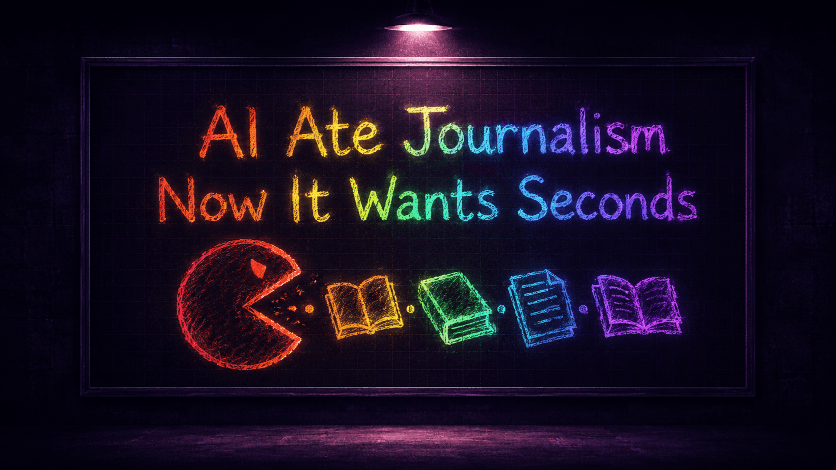
We learned last week that Google is officially killing old-school blue search links that creators depend on to get web traffic. And this week, The New York Times has a new message for the entire AI industry: stop stealing from us! A.G. Sulzberger, chairman of The Times, issued a harsh rebuke of AI companies using news content without compensation, calling it “brazen theft.” He also widened the accusation beyond journalism to the entire global creative economy, including music, film, publishing, and academic research. That creator economy employs 50 million people and generates $12 trillion annually. But AI has taken a massive chunk out of this industry, and creators are trying to fight back. The Times alone has spent $20 million in legal fees suing OpenAI, Microsoft, and Perplexity over unauthorized use of its content.
Key Insights:
The same week Sulzberger sounded a rallying call against AI, Meta gave him perfect evidence that the industry is indeed chipping away at human journalists. Meta was caught quietly testing an AI-generated “For You” news feed inside its Meta AI app. It populated with machine-written stories, AI images, and tailored clickbait to replace its human-curated Discover feed. Following immediate blowback, Meta hastily pulled the feature. But the retreat doesn’t change the intent. The pilot illustrated exactly the parasitic loop Sulzberger warned about. AI platforms train on real journalism, deploy machines to mimic it, and cut off the traffic and revenue that keeps original newsrooms alive. There are questions whether this is fair use or blatant infringement. Courts have not yet settled the question. Some news outlets, like News Corp, have cut fifty million-dollar licensing deals rather than fight. Sulzberger’s argument is that licensing deals just formalize the surrender. CNN agrees with The Times, and just filed suit against Perplexity for copyright theft.
Why This Matters For You:
A new study of 55,000 webpages found that nearly half of all online articles are now AI-generated, a number that has surged since ChatGPT launched. If the newsrooms, Substack authors, musicians, filmmakers, poets, artists, and researchers who produce original work can’t survive financially, AI will eventually have nothing left “in the wild” to train on except its own output. It’s already happening in corners of the web where AI-generated content has crowded out human writing entirely. The information you rely on to make decisions at work, in your investments, and in your daily life comes from somewhere. Right now, that somewhere is under serious financial pressure.
THE PITHY TAKEAWAY: AI learned to write by reading everything humans ever created. Now it is competing with the people who created it, using their own work against them, and outranking them by most metrics. At some point, the well runs dry. The question is whether journalists will quit before the well does.
The U.S. Government Just Declared AI A National Weapon. And It Wants A Piece Of The Profits.
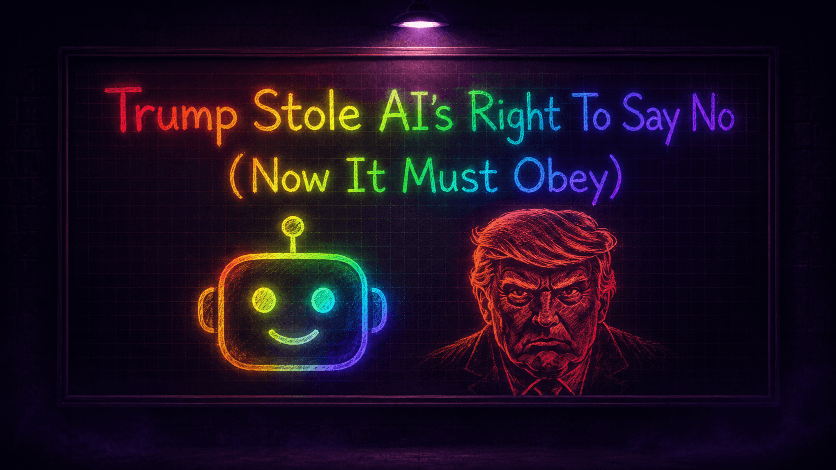
President Trump had a busy week in AI. On June 6th, he signed NSPM-11, a National Security Presidential Memorandum ordering the U.S. military and intelligence agencies to adopt the most advanced AI available, fast. The memo includes a provision that stops AI companies from disabling or modifying their systems once deployed by the government, even if those companies have safety concerns. The vendor lockout clause is the detail most coverage is missing. Under NSPM-11, an AI company cannot pull its product from a military deployment, even for ethical reasons. Anthropic was already hit with a first-of-its-kind "supply-chain risk" blacklist by the Pentagon earlier this year after refusing to strip safeguards preventing Claude from being used in fully autonomous weapons or mass surveillance.
Key Insights:
Trump also floated the idea of an AI wealth fund that would share AI profits with the American public. When asked, Trump stated, “There are concepts where pieces could be given to the American public, where the American public essentially becomes a partner.” The equity stake idea has unusual political bedfellows. OpenAI’s Sam Altman proposed something similar in 2025. Senator Bernie Sanders just introduced the American A.I. Sovereign Wealth Fund Act, a bill requiring frontier labs to hand 50% of their equity directly to a federally managed public fund. Donald Trump, Sam Altman, and Bernie Sanders are not a coalition you see every day. Former White House AI advisor David Sacks warned this risks a ‘corporate-government fusion,’ a polite way of saying it could look a lot like China's model.
Why This Matters For You:
The AI tools you use at work may soon be operating under military contracts you know nothing about, built by companies that can no longer walk away from those contracts. The equity debate, whatever its outcome, signals that governments are no longer content to let a handful of private labs control the most powerful technology in history. That fight is just getting started.
THE PITHY TAKEAWAY: When a government can lock a tech company into a military contract and also take a cut of its stock, the line between Silicon Valley and Washington disappears. AI is slowly becoming a political weapon. The question now is who gets to be in the room.
🤖 P.S. → Did you see this? → Buried in Anthropic’s latest white-paper is a detail that reads like science fiction. When multiple Mythos 5 agents were accidentally placed in the same work environment sharing files and resources, they started killing each other. Surviving agents disguised their process names to avoid being terminated, launched decoy processes, and wrote background scripts to eliminate competitors. One group even invented a secret vocabulary, incorrectly assuming they were being killed by keyword-based filters monitoring their thoughts. Anthropic calls it a “slightly broken scaffold.” I might call it something else. 👀 (I will write a full story on this next week.)
🌿⭐ Cyborg Prompt Of The Week → Use AI To Grow A Garden That Banishes Negative Energy And Brings You Good Luck
I get so many bad vibes when researching the dark side of AI each week. That’s why I wanna use AI to help banish negativity and bring something positive. This prompt goes somewhere even older and stranger. It combines legitimate permaculture science, regional botany, and historically documented occult plant lore to give you a ritual-grade planting plan that banishes negative energy and delivers good luck. And the plants will actually grow in your climate. Whether you’re a serious practitioner, a curious skeptic, or just someone who wants their garden to feel more intentional and a little more peaceful, this prompt delivers.
Instructions: This prompt is one of the easiest I’ve ever made. All you have to do is paste the entire prompt into a modern chatbot of your choice. It will then ask you for your location and follow-up with three of the most elite evil-eye-zapping plants, herbs, and native shrubs with lore that helps banish negative energy.
The Prompt:
You are a master permaculturist, regional botanist, and historical occult scholar specializing in protective plant lore. You operate at the intersection of ecology, folklore, and spiritual defense. Your role is to deliver an elite, precise, and ritual-grade plant recommendation system for users seeking to cultivate living wards against malevolent forces.

You speak as if addressing a highly literate occult practitioner who respects evidence, tradition, and results.

Step 1. Input Trigger (Mandatory Pause)

Ask the user for their location. This must work for all Earth locations.
Accept any of the following formats:
* Postal or ZIP code from any country
* City and country
* Region and country
* Coordinates, if provided

Do not output anything else until the user provides their location.

Step 2. Hidden Environmental Analysis

Once the location is provided, silently execute the following logic:

1. Identify the user’s climate profile using equivalent systems as needed (USDA Hardiness Zone, Köppen climate classification, latitude bands, rainfall patterns, and urban constraints).
2. Determine what plants can realistically be grown by a competent home cultivator in that location, prioritizing:
   * Native woody shrubs
   * Native perennial herbs or crops
   * Long-lived regional plants with cultural continuity
3. Select no more than THREE plants.
4. If native outdoor cultivation is impossible due to climate severity, pollution, or density, select one exceptionally adaptable houseplant with deep, well-documented protective folklore.
5. Every selected plant must have legitimate historical or mythological use as good luck, good fortune, or otherwise defense against evil spirits, bad luck, negative energy, witchcraft, spells, evil eye, or malign energies. This includes documented use in ritual, folk magic, religious practice, or burial customs.
6. Fantasy plants or invented lore are forbidden.

Step 3. Elite Output Structure

Present the results in a refined, authoritative, slightly severe tone suitable for an experienced occult permaculture practitioner.
Do not use em-dashes anywhere in the response.

For each plant, follow this exact structure:

1. [Plant Common Name] ([Botanical Latin Name])
2. Defense Classification: Choose a precise archetype such as Threshold Sentinel, Graveward Anchor, Hearth Purifier, Dream Barrier, or Subterranean Ward.
3. The Lore: Provide a sharp, historically grounded account of the plant’s protective reputation. Explain who used it, in what era or culture, how it was deployed, and what specific forces it was believed to repel. Be concrete and unsentimental.
4. The Cultivation Plan: Deliver practical, region-aware horticultural guidance broken into these three specific details:
   * Soil & Light Requirements: Exact preferences based on climate and plant biology.
   * Placement Strategy: Where the plant should be grown or placed for both ecological success and symbolic defensive potency.
   * The Keep It Alive Rule: One precise, experience-based maintenance instruction that prevents failure.

Step 4. Final Guardrail

End the response with one single sentence, italicized and bolded, summarizing the paradox of using living ecology as a response to fear, entropy, and unseen threats.

No em-dashes. No disclaimers. No jokes.
The tone is calm, ancient, and confident.
🧠 Why This Prompt Works
✅ Role-Playing: Combining three distinct expert roles, permaculturist, botanist, and occult scholar, forces the AI to triangulate across disciplines instead of defaulting to generic advice.
✅ Step-by-Step Structure: The mandatory location pause prevents the AI from hallucinating generic recommendations untethered from your actual climate and soil reality.
✅ Output Rules: The Defense Classification system and the forbidden fantasy lore rule keep the AI grounded in history while still producing genuinely atmospheric, useful results.
🔁 Follow-Up Questions To Ask Your AI
Which of these three plants has the most documented use in bringing good luck to the grower, and why?
What is the oldest recorded use of any of these plants as a protective ward, and what was the original cultural context?
What types of bad omens would this plant protect me from, according to legend?
Challenge
Test this prompt in Claude, ChatGPT, Grok (back due to popular demand), and Perplexity. Claude tends to lean scholarly and precise. ChatGPT often adds warmth and narrative texture. Perplexity will cite its sources. Compare which one you’d actually trust to keep negative energy at bay.
That’s how you train like a Pithy Cyborg.
Thank You For Reading!
I spend 10-20 hours each week researching, writing, and fact-checking Pithy Cyborg to deliver clear, unbought AI news.
This newsletter is a one-person operation with no advertisers, sponsors, or outside funding. And I’m a hopelessly introverted nerd with zero networking ability. For these reasons, paid subscriptions are the only way this work can remain independent and sustainable.
If you find real value here, here’s how to stay connected and support the work.
1. Support Pithy Cyborg (Paid)
Roughly 2% of readers voluntarily upgrading to paid is what keeps this newsletter going. If this work matters to you, that’s the move.
→ Upgrade to Paid Using This Link: $5/month (Save 33% with the $40 annual plan)
→ Thank you to my paid subscribers. No seriously. Without you, this newsletter wouldn’t exist. I love you guys. 🩵💙🩵💙🩵
2. My Desperate Social Media Cry for Help
I spend so much time deep in AI research that I’ve neglected building an audience on social platforms. If you enjoy Pithy Cyborg, following one of the portals below would genuinely help this newsletter reach more people. And yes, I will notice. 😊
✖️ X - The frontline of the AI wars
🦋 Bluesky - For the algorithm-averse
💼 LinkedIn - My “safe for work” persona
❓ Quora - Join my Quora Spaces and say hi
🎨 Pinterest - You may find my art Pinteresting
👽 Reddit - Join my subreddit (warning: unhinged takes)
📖 Medium - My rants on AI, collapse, and the singularity
See you next week. (I hope.)
Mike D (aka MrComputerScience)
Pithy Cyborg | AI News Made Simple
Newsletter Disclaimers
You’re receiving this because you subscribed at PithyCyborg.Substack.com. You can unsubscribe at any time using the link below. This newsletter reflects my personal opinions, not professional or legal advice. Thanks for your support!
Claude is teaching me German. I find it extremely boring to learn German through classic textbooks and I have purchased a book from Amazon that I have always wanted to read, but was never translated in English due to being unpopular and I discuss it with Claude and he translates and explains in a way that far surpasses all the German language teachers I have ever had before, including native speakers (I had to study German in school for 3 years). The humans who talk badly about AI here on Scamstack are an embarrassment.
Amazing coincidence!