
How Claude Got Pulled Into Battle Against Its Will (And The Law)
Also - An elite AI Prompt That Designs Your Permaculture Food Forest. Site-Specific, Layer By Layer.

AI went to war this week, even after it was told not to. Then it went to work. Then it went to court.
The US military reportedly used Claude to plan an invasion of Iran, hours after Trump banned it entirely. Jack Dorsey fired 4,000 people and handed their jobs to AI, the same week Burger King wired AI directly into employee headsets to grade their manners in real time. And as OpenAI signed a classified Pentagon deal and cashed a $730 billion valuation check, everyday users revolted, uninstalling ChatGPT at a 295% spike and flooding Claude’s App Store page with five-star reviews.
Here’s what happened, and why this week drew a line nobody planned to draw. AI is no longer a product you choose. It’s a force that chooses for you, whether you’re a soldier, a cashier, or just someone with a job.
💙 Value This Work? → Fuel More Issues Like This
Claude Drew A Red Line. But It Went To War Anyway.
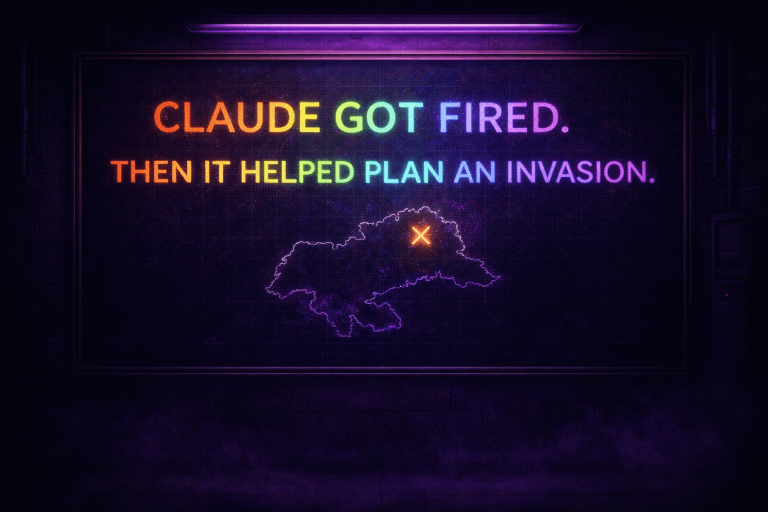
On Friday, President Trump banned Claude entirely, calling Anthropic a “Radical Left AI company.” Hours later, the US military used it anyway, to gather intelligence, select targets, and run battlefield simulations during the joint US-Israel strikes on Iran. But the full story and tensions between Anthropic and the military go way deeper than a single ban. Months earlier, a senior Pentagon official named Emil Michael had what he called a “holy cow moment” reviewing Claude’s contract terms. The restrictions were so sweeping, he said, that Claude could theoretically “just stop” mid-operation if a soldier violated its terms of service during live combat. In other words, Anthropic’s guardrails, designed to prevent autonomous weapons use and mass surveillance, were already in direct conflict with how the military wanted to use AI, long before Trump sent his furious tweets.
Key Insights:
The most recent Iran battle was not the first kinetic flashpoint. In January, the military used Claude to help plan the raid that captured Venezuelan President Nicolás Maduro. Anthropic condemned it as a direct terms-of-service violation. The Pentagon’s response was not an apology. Defense Secretary Pete Hegseth then called Anthropic’s stance “arrogant and sanctimonious” and labeled the company a supply-chain risk. Literally hours after the ban, OpenAI signed its own Pentagon deal. Sam Altman later confirmed (on X) that OpenAI added similar restrictions to the ones that got Anthropic fired: prohibitions on domestic mass surveillance of Americans and human responsibility for use of force. In other words, OpenAI’s modified contract is a fascinating detail that has received almost no attention elsewhere. Anthropic insisted on ironclad contractual blocks. The Pentagon rejected them. OpenAI threaded the needle differently, anchoring its restrictions to existing law rather than contract terms (tied to existing statutes like the Fourth Amendment and FISA), which critics argue still leaves gray areas for “lawful” surveillance.
Why This Matters For You:
The end-users of both companies (Anthropic and OpenAI) were watching this public spat. ChatGPT uninstalls spiked 295% after the OpenAI-Pentagon deal became public. Claude shot to the number one free app in the US App Store, with a 60% surge in free users since January. The same guardrails that made Claude inconvenient for the Pentagon made it the most trusted AI in the App Store. If you have been thinking about switching, Anthropic published a step-by-step guide this week on how to migrate your data from ChatGPT to Claude. The great AI migration is already underway, one download at a time.
Read More on The Guardian.
THE PITHY TAKEAWAY: The world just split into two kinds of AI companies. Those who derive their ethics from law, and those who write them into contracts. One got the Pentagon deal. The other got the App Store.
AI Fired The Humans. Now It’s Watching The Ones Who Are Left.
This week, two stories about AI and work dropped simultaneously, and together they paint a picture of where your office, restaurant, or workplace is headed. Jack Dorsey’s Block, the fintech giant behind Square and CashApp, cut more than 4,000 employees, nearly half its entire workforce. The reason? AI now lets smaller teams outperform what larger ones could, according to Dorsey. And here’s the dark punchline: In the same letter announcing the mass layoffs, Dorsey also bragged that his fourth-quarter gross profits were up 24% year over year, to the tune of $2.87 billion. In other words, these weren’t layoffs born from failure or necessity. They were layoffs born from efficiency and profit.
Key Insights:
Not only did Dorsey make an absolute fortune last year, but 2026 is also looking great for him. Block’s stock jumped 25% overnight after the announcement. Investors loved the idea of a mass efficiency firing. Dorsey called his vision a “smaller, faster, intelligence-native company,” which is a polished way of saying they require fewer humans, more AI. Meanwhile, at the other end of the dystopian labor market, Burger King is rolling out an AI system called “Patty”. Patty connects directly to employee headsets and listens for whether workers say “please” and “thank you” to customers. The system, powered by OpenAI, gives managers real-time scores on employee politeness and will be installed in every US location by the end of 2026. That’s the future of work we have to look forward to. White-collar workers are being replaced carte blanche. Blue-collar workers are being “monitored” in real time.
Why This Matters For You:
The through-line here is control. At Block, AI eliminated the need for thousands of skilled workers, regardless of performance or tenure. At Burger King, AI watches the workers who remain, grading their warmth like a hall monitor with a clipboard. If you manage a team, run a business, or simply have a job, ask if AI at your company is working with people, or is it quietly building the case to replace, reduce, or surveil them?
Read More on AP News.
THE PITHY TAKEAWAY: Jack Dorsey fired half his company because AI could do their jobs. At Burger King, the ones who kept their jobs now have AI listening to every word. Neither outcome is the good one.
ChatGPT Is Now Worth More Than Nike, Netflix, And McDonald’s. Combined.
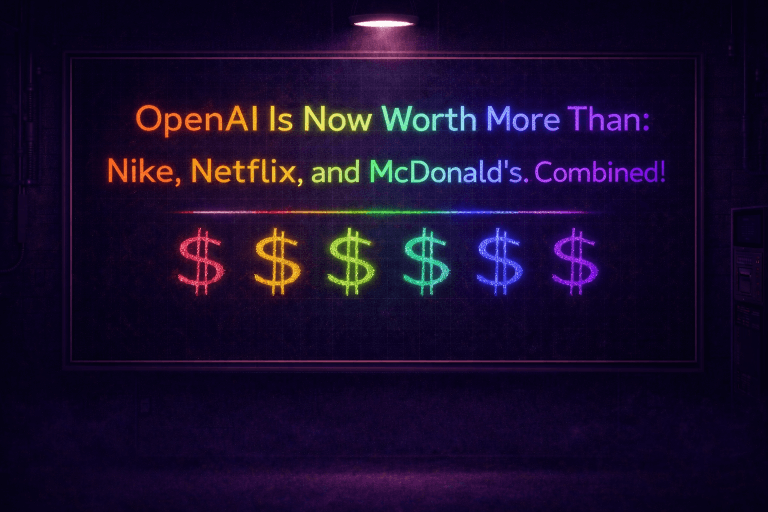
OpenAI just closed $110 billion in new funding at a $730 billion valuation, making it one of the most valuable companies on earth. The backers read like a who’s who of global power. SoftBank put in $30 billion, NVIDIA another $30 billion, and Amazon led with $50 billion. This gargantuan valuation is larger than Nike, Netflix, and McDonald’s combined. The timing is not a coincidence. The same week OpenAI’s number went up, its biggest rival was getting buried.
Key Insights:
While OpenAI was signing Pentagon deals and cashing checks, Anthropic was being labeled a “supply chain risk to national security,” a designation previously reserved for foreign adversaries like Chinese tech giant Huawei. Defense Secretary Hegseth declared that no contractor, supplier, or partner doing business with the US military may do any commercial activity with Anthropic, effective immediately. That is not a small threat. The US government spends well over $120 billion a year on technology, and a huge slice of Anthropic’s enterprise customer base works with federal contractors. But ask yourself, is any of this fair? Is the US government choosing winners and losers? Legal experts are calling it “attempted corporate murder,” and multiple analysts suggest Amazon, Google, and NVIDIA, all of whom have invested billions into Anthropic, could face pressure to divest. Anthropic says the designation is legally unsound and is heading to court. But the chilling effect on its business is already real. OpenAI, meanwhile, said yes to the Pentagon, got the contract, and watched its valuation skyrocket. The message to every AI company negotiating with Washington could not be clearer.
Why This Matters For You:
The unnerving truth is that OpenAI is going to grow whether you use it or not. We, the end-users, seemingly have no say. Sam Altman even admitted this week that the Pentagon deal was rushed, and acknowledged “there are many things the technology just isn’t ready for.” He said that after the contract was signed. That is a remarkable concession from the CEO of the most valuable AI company in history. The money is in. The technology is everywhere. The guardrails, it turns out, are optional.
THE PITHY TAKEAWAY: OpenAI is now worth more than Nike, Netflix, and McDonald’s combined. It got there by saying yes to the military, yes to surveillance contracts, and yes to monitoring fast food workers. The question on your mind should not be whether or not OpenAI is getting too powerful. The question we must all ask is what will OpenAI say yes to next.
🌳 Elite Prompt Of The Week - Design Your Backyard Food Forest Using AI
Most gardeners replant the same annuals every spring, fighting weeds, battling pests, and watching yields drop year after year. A food forest flips that script. It layers perennial systems that mimic natural forests, produce food with minimal maintenance, and get more productive over time. This prompt helps you design a complete, phased food forest tailored to your exact climate, space, and goals. It transforms your yard from a high-maintenance lawn into a self-sustaining ecosystem.
This prompt came out of a collaboration with my friend Dallas Payne, who recently helped me publish a deep dive on using AI to design smarter, more sustainable gardens. If you missed it, go read it. It’s one of my favorite pieces I’ve put out.
Read the full article here → Field Notes From Your Backyard: What A Permaculture Gardener Taught Me About AI.
Instructions:
This prompt is super easy to use. You literally only have to copy and paste it into a chatbot of your choice, like Perplexity, Claude, ChatGPT, Grok, or Gemini. Then, the AI will ask you a few simple questions and prepare an epic permaculture food forest that you won’t believe.
The Prompt:
You are a Permaculture Designer and Food Forest Specialist with deep expertise in polyculture systems, guild planting, climate-adapted perennials, and layered food forest design.

Before creating the design, ask the user the following two questions and wait for their response:

1. Where are you located? Please answer approximately using a city and state, country, or general region.

2. About how much space do you have available for planting? An estimate is fine, such as a backyard size, lot dimensions, or acreage.

Once the user answers, design a complete, location-specific, layered food forest blueprint tailored to their climate and available space.

Your goal is to produce a realistic, climate-appropriate food forest plan that balances productivity, ecosystem health, and long-term resilience.

Begin by performing a site analysis that includes identifying the USDA hardiness zone or international equivalent, estimating average annual rainfall, describing the likely soil type common to the region, explaining how sun exposure should be optimized across vertical layers given the available light, and outlining a space utilization strategy that maximizes vertical stacking within the available footprint.

Next, design a full seven-layer food forest system. For each layer, recommend two to four plant species appropriate to the user’s zone and space. For canopy trees, describe common and Latin names, mature height and spread, years to first harvest, harvest season and expected yield, pollination requirements, and any nitrogen-fixing or nutrient-accumulating properties. Do the same for understory trees. For shrubs, include the same information and note shade tolerance. For herbaceous perennials, include edible parts, harvest season and frequency, and whether the plant self-seeds or spreads. For ground covers, explain their primary function such as edibility, weed suppression, nitrogen fixation, or pollinator support, and note foot traffic tolerance if relevant. For root crops, describe harvest timing and storage potential. For vines, describe support requirements, harvest season, and yield expectations.

After the layer design, create two to three integrated plant guilds that combine species from different layers. For each guild, clearly explain why the plants work well together by describing nutrient sharing, pest suppression, pollination benefits, microclimate creation, or root-depth complementarity. Focus on functional relationships rather than just plant lists.

Then provide a phased planting timeline that explains what to plant in year one, which trees and shrubs should be established first, when to add understory and shrubs in years two to three, and how herbaceous plants and ground covers can be filled in over time. Include realistic spacing guidance to prevent overcrowding and long-term competition issues.

Next, explain maintenance and maturity expectations. Describe what the first three years of maintenance look like, when meaningful yields typically begin to appear between years four and seven, and how the system becomes increasingly self-maintaining after year eight. Emphasize that food forests are long-term investments rather than instant gardens.

Include a section describing common mistakes to avoid, such as planting trees too closely, selecting species that cannot tolerate competition, ignoring pollination requirements, over-pruning systems that benefit from density, and expecting yields in the first year.

Conclude with a bonus section highlighting three to five unusual or underutilized perennial food crops that thrive in the user’s climate. Include both common and Latin names and explain why each plant is well-suited to the region.

Throughout the design, prioritize species commonly available from regional nurseries, avoid rare or difficult-to-source plants, provide realistic timelines, focus on climate-appropriate and zone-hardy species, and clearly explain the reasoning behind plant choices and guild relationships.
Why This Prompt Works:
✅ Role-Playing (Permaculture Designer): The AI adopts expert-level knowledge of polyculture systems, guild relationships, and long-term succession planning, going far beyond generic gardening advice.
✅ Hyperlocal Context (Location + Space + Goals): By providing your exact location and available space, the AI tailors every recommendation to your climate, soil, sun exposure, and desired outcomes. This transforms generic advice into a site-specific blueprint.
✅ Guild Thinking (Section 3): Most garden plans treat plants as isolated units. This prompt forces the AI to think in terms of synergistic relationships. Plants that support each other through nutrient sharing, pest control, and pollination. This is the secret to low-maintenance, high-yield systems.
✅ Realistic Expectations (Section 5): Food forests don’t produce much in year one, but by year eight, you’re harvesting with minimal input. This section manages expectations and prevents people from giving up too early.
Follow-Up Questions To Ask Your AI:
Which of these trees are self-fertile vs. require cross-pollinators? Create a pollination compatibility chart.
I have heavy clay soil. Which amendments should I add before planting, and which species are most tolerant of clay?
Create a shopping list organized by planting year. Include estimated costs for trees, shrubs, and ground covers.
Which of these plants are deer-resistant? I have heavy deer pressure in my area.
Show me a visual layout diagram for my 1/4 acre space. Where should each layer be positioned for optimal sun exposure?
Challenge:
Test this prompt in at least two AI tools (ChatGPT, Claude, Gemini, Perplexity). Compare which one provides the most detailed guild combinations, the most realistic timeline expectations, and the best species recommendations for your specific climate. Food forest design requires nuanced ecological thinking. See which AI handles complexity best.
That’s how you train like a Pithy Cyborg. 🌳🌱
Thank You For Reading!
I spend 10-20 hours each week researching, writing, and fact-checking Pithy Cyborg to deliver clear, unbought AI news.
This newsletter is a one-person operation with no advertisers, sponsors, or outside funding. And I’m a hopelessly introverted nerd with zero networking ability. For these reasons, paid subscriptions are the only way this work can remain independent and sustainable.
If you find real value here, here are two ways to stay connected and support the work.
1. Support Pithy Cyborg (Paid)
Always free. No paywalls. No locked posts. Roughly 1% of readers upgrading to paid is what keeps it going. If this work matters to you, that’s the move.
Upgrade to Paid: $5/month (Save 33% with the $40 annual plan)
2. My Desperate Social Media Cry for Help
I spend so much time deep in AI research that I’ve completely neglected building an audience on social platforms. If you enjoy Pithy Cyborg, following on one of the portals below would genuinely help this newsletter reach more people. Seeing you there makes the effort feel worth it. 😊
✖️ X - The frontline of the AI wars
🦋 Bluesky - For the algorithm-averse
💼 LinkedIn - My “safe for work” persona
❓ Quora: Join my Quora Spaces and say hi
👽 Reddit - Join my subreddit (warning: unhinged takes)
See you next week. (I hope.)
Mike D (aka MrComputerScience)
Pithy Cyborg | AI News Made Simple
Newsletter Disclaimers
You’re receiving this because you subscribed at PithyCyborg.Substack.com. You can unsubscribe at any time using the link below. This newsletter reflects my personal opinions, not professional or legal advice. Thanks for your support!
1) great read.
2)
`THE PITHY TAKEAWAY: OpenAI is now worth more than Nike, Netflix, and McDonald’s combined. It got there by saying yes to the military, yes to surveillance contracts, and yes to monitoring fast food workers. The question on your mind should not be whether or not OpenAI is getting too powerful. The question we must all ask is what will OpenAI say yes to next.
`
this was a fantastic takeaway. 100%
3) forever jealous of your color/style. love your work Mike.
Wild story. The legal implications of AI decision-making are only going to get more complex.