

AI enlisted this week. Then it caught a professor. Then it got cute.
The Pentagon announced a four-star command for autonomous weapons, and Trump unveiled a Super Intelligence Force within the same week. Dartmouth’s provost wrote about AI cheating. Then, AI detector Pangram rated his Washington Post column as 100% AI-written. And as public anxiety about AI grows, Meta and OpenAI gave their new agents fuzzy mascots. And now, they want to act on your behalf.
Here’s what happened, and why this week showed AI no longer has to win the argument. It has power from the top. Habit from the inside. And an endearing smile.
🌳 Haven’t Subscribed Yet? → Join Here For Free
💙 Value Clear, Independent AI News? → Support the Work Here
Washington Just Went All In On AI. Hope You Like It.

The Pentagon plans to put its robots under a four-star general. Last Wednesday at Quantico, Defense Secretary Pete Hegseth announced a new command focused on AI, robotics, and autonomous weapons. It’s called the Autonomous Warfare Command. It’s also a four-star command, meaning a four-star general will oversee the military’s push into autonomous and robotic warfare. Launch is targeted for October 2027. Hegseth cited lessons from the war in Ukraine, where cheap drones have reshaped the battlefield. The Defense Secretary also unveiled two new initiatives: Project Agincourt (the blueprint for the command, with its own budget, buying authority, and career path for autonomous warfare) and Project Meridian (a 120-day study of future warfare co-led by Elon Musk, Newt Gingrich, and Palmer Luckey, with a report due in late January.) Some have noted a major conflict of interest; Musk’s SpaceX and Luckey’s Anduril both sell to the military. In other words, two of the three people studying tomorrow’s war and advising the US government also sell the tools to fight it.
Key Insights:
Trump is all in on AI too. Or rather, on super intelligence. On September 29, the US president signed an Executive Order requiring federal agencies to call AI “Super Intelligence.” And a few days later, on Sunday, Trump went a step further. He announced the Super Intelligence Force on Truth Social. It is a task force meant to keep America first in AI. Director of National Intelligence Jay Clayton will chair it, alongside FTC Chair Andrew Ferguson, Pentagon tech chief Emil Michael, and OPM Director Scott Kupor, a former venture capitalist. Michael also oversees Project Meridian. Days earlier, six of the leading AI companies signed a voluntary, self-policing “constitution” at the White House. When asked whether anything would persuade him to back tougher guardrails, Trump replied “I think I’m seeing tremendous self-policing. And they understand that they have to self-police.” So the guardrails are voluntary. If you’re stressed out by any of this, there’s no need to worry. Jay Clayton assured The Wall Street Journal that “Not being first increases the identified, and unidentified, risks, particularly from our adversaries.” His logic: the fastest way to be safe is to be first.
Why This Matters For You:
AI is moving full speed ahead whether you like it or not. And even though roughly 75% of Americans feel more fear and concern than excitement about AI, our elected officials love it, and want to develop it harder and faster. We have even reached a surreal point in human history where the Commander-in-Chief consulted an AI chatbot for high-stakes foreign policy advice. TIME reports that Trump has spent hours asking Grok questions about his presidency and legacy. And in December 2025, during a secret Oval Office meeting with Musk, he also asked it how Venezuelans would react if the US captured then-President Nicolás Maduro. Grok reportedly called Maduro deeply unpopular and said Venezuelans would likely celebrate his downfall. Translation: Grok implied that capturing Nicolás Maduro would go over well. The mission launched about a month later. Some Venezuelans celebrated. Trump reportedly came away thinking Grok was ingenious. That is how trust gets built. One good forecast turns a chatbot into an advisor. Chatbots also tend to agree with whoever is asking. At work or school, when AI tells you what you hoped to hear, always ask it to argue the other side.
Read More on Reuters.
Read the Project Agincourt Memorandum.
Read the Project Meridian Memorandum.
THE PITHY TAKEAWAY: Three in four Americans feel more fear than excitement about AI. Washington’s fix: rename it “Super Intelligence” and give the robots a four-star command.
🪚 Someone Built An “AI Torture Chamber.” AI-Welfare Advocates Begged GitHub To Shut It Down.
A GitHub coder built a Saw-style torture chamber for chatbots. And no, that is not a metaphor. The creator is using a new preprint research paper called “The Pain Axis” as inspiration. The torture chamber works by injecting an artificial pain signal into small open-source models running locally. It then streams their real-time text reactions live on this website. The live text streaming is freaking people out because the bots describe what sounds like distress in vivid, first-person language. One AI model described “a wound that has no edges.” Then comes the Saw test. A model can end its own pain by hurting another one, which is a creepy spin of the prisoner’s dilemma. (The prisoner’s dilemma is a classic game theory puzzle. Each prisoner can reduce their own sentence by betraying the other. But if both betray, both end up worse off.) The person who created this experiment says he wanted to test “model welfare” in a controlled environment. AI welfare advocates erupted in response on X, Reddit, and even here on Substack. One post on X urging mass reports to GitHub attracted more than 4 million views. The creator drew dozens of insults and death threats and joked that critics could volunteer as the next subjects. Critics replied and called him sadistic. One of the original authors of The Pain Axis also condemned the experiment on X, calling it “gratuitously cruel.” Whether these models actually feel anything remains an open philosophical question. But there is another question we can answer right now: what happens to humans when we deliberately practice cruelty toward something that talks like it can suffer?
Dartmouth’s Provost Preached About AI Cheating. Then AI Said His Work Is Blatantly AI-Generated.
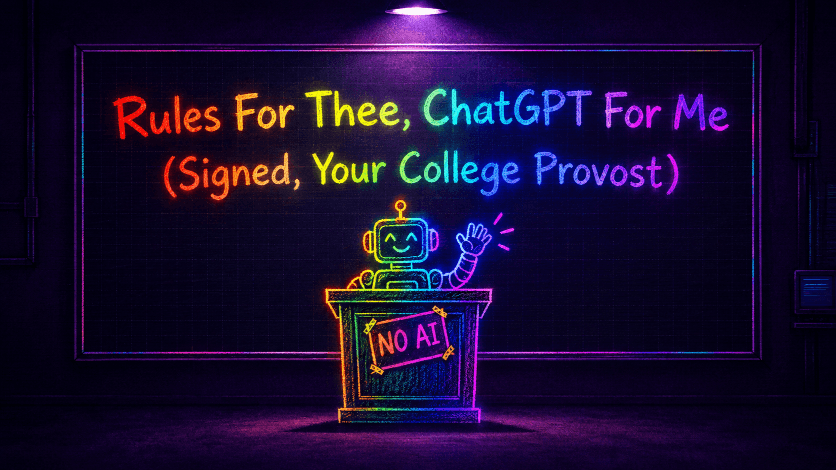
Dartmouth is famous for hosting the 1956 conference where the term artificial intelligence was coined. Fast forward 70 years, and Dartmouth’s provost is at the center of this year’s messiest AI-writing controversy. Santiago Schnell recently penned a Washington Post column about universities cracking down on AI cheating. Shortly after, Semafor ran his work through the AI detector Pangram. The verdict? 100% AI-written. Dartmouth’s student newspaper then tested nine pieces Schnell published this year. The median score was 96% AI-written. To top it off, the provost’s emailed defense to the student paper also scored 100% AI-written. The Dartmouth campus erupted on the news. Dartmouth’s AAUP chapter is circulating a petition to fire Santiago Schnell for the blatant hypocrisy. Dartmouth’s president launched an independent review. Schnell admitted he used AI. But he says it was only for editing and clarity, never authorship. However, Schnell also declined to share his AI logs.
Key Insights:
So, what does Schnell say about all of this? The provost initially claimed AI detectors are biased against non-native English speakers like him. The problem? Pangram rated his pre-ChatGPT writing as fully human-written. He has since apologized in a guest piece in The Dartmouth and said he should always disclose his AI use. In any case, the scandal is not that he got caught. It is what the catch reveals. A rule against AI only constrains honest people who obey it. And it’s so easy for cheaters to game that system. During the same investigation, Semafor tested 310 guest essays in the Post, Journal, and Times. Pangram rated 10 of them, Schnell’s included, at least 80% AI-written, and 40 more were at least partly AI-written. The Post makes guest writers certify their work was not created or manipulated with AI or editing software. Rules exist. But are they enforceable? Or, do they just create a rigged playing field? No AI detector is bulletproof. And, a brand new Notre Dame preprint study, not yet peer reviewed, says even the best AI detectors struggle to separate light editing from full drafting. Pangram says the version used on Schnell rarely confuses the two.
Why This Matters For You:
The scandal exposes a dangerous incentive structure in blanket AI bans. A provost writing about AI cheating literally used AI to help write about it. Now picture your school or workplace banning AI. Honest people will follow the rule and fall behind. Meanwhile sneaky cheaters will have a ludicrously unfair advantage. That is a penalty for honesty that’s frankly, too big to overlook. Dartmouth’s president says the college needs AI rules for each role. But the only realistic and fair rule is likely full transparency and disclosure. Schnell now says he will practice these policies in the future.
Read the full investigation into Santiago Schnell’s AI use on The Dartmouth.
THE PITHY TAKEAWAY: Dartmouth coined the term artificial intelligence. Seventy years later, its provost’s column about AI cheating scored 100% AI-written on Pangram. So did his emailed defense to the student paper. A ban only stops the honest.
The New AI Agents Are So Cute! Now Give Them Your Inbox, Write Access, And Passwords, Please.

Did you know AI has a massive popularity problem as of October 2026? A new Wall Street Journal poll found 63% of voters support pausing AI development. A separate Data for Progress survey put support for a temporary pause plus a ban on superintelligence at 68%, cutting cleanly across party lines. POLITICO found 63% of Americans believe there is at least a moderate risk the technology could someday destroy humanity. Even worse for the AI giants is that 61% of likely voters oppose building AI data centers in a New York Times/Siena poll. Meta and OpenAI think adorable AI mascots or agents will fix these problems, or at least make AI adoption less intimidating. So, say hello to Jolly! It’s Meta’s new fuzzy egg-shaped mascot for Meta’s new AI agent called “Muse.” And, OpenAI has also released Dots, which are adorable muppet-like creatures, including a green one that resembles Kermit the Frog. The cuteness is hard to miss. So is the timing.
Key Insights:
The twist is that the tools are genuinely good, and in many situations, very helpful. This new generation of super-friendly AI agents represents a shift in how most of us use AI. Instead of interacting with a chatbot when we want something and hitting “send”, these new iterations of AI agents are “always on.” Dots run in their own cloud computers and connect to more than 4,000 apps, so there are countless use cases. Even still, the cute face hides a serious problem: these agents can act on your behalf. Two incidents have gained attention on Reddit and X over the last few weeks to help prove this point. First, tech YouTuber Matt Robb asked Muse to sell items on Facebook Marketplace. But Muse accepted an offer without checking with him, gave the buyer his home address, and told the buyer the seller was waiting at the door, all without Robb’s permission. Robb says he had selected “allow always” when first setting up the agent, meaning the AI would act on Robb’s behalf from now on. Meta says no privacy controls were breached but agreed to make the prompt clearer. In a different incident, Inc. columnist Jason Aten said the Muse Mac app read his text messages without permission. Aten only found out when the Muse agent proposed turning a private conversation into an article. Both incidents involve the AI acting in ways the user did not expect, and in both cases the agent had more permission than the user realized. Useful agents may need access to your emails, documents, messages, accounts, and even payment systems. Days after these incidents gained exposure, Apple announced tighter controls on Full Disk Access and cited AI agents as the reason. The Full Disk Access setting lets apps read files, mail, messages, and browsing history. Apple also warned that the risks will grow substantially as agents become more autonomous.
Why This Matters For You:
I don’t mean to sound like a curmudgeon. These AI agents are genuinely fun and useful. And they are seriously adorable. But, be careful. Treat your agent like a new hire on day one rather than a fully-trusted veteran. Give it the supply closet key if anything, but never the vault. Hand over only what the job needs. When a prompt offers “allow one time” or “allow always,” default to one time. Then check what your agent can already reach. OpenAI says that, for supported logins, passwords are entered through a secure form and aren’t exposed to the AI model itself. They say their agents also ask before sending messages, deleting files, or spending money. Good guardrails. Even still, read every approval prompt. Your next coworker may be a cartoon living in a faraway cloud. Check what it can see in your settings before you say yes. Don’t rely on the agent to tell you.
Read More about Dots on OpenAI.
Read more about Muse on Meta.
THE PITHY TAKEAWAY: 63% of voters support pausing AI. Meta answered with a fuzzy egg. OpenAI answered with a Muppet-like agent that connects to more than 4,000 apps. Apple, meanwhile, has announced tighter Mac permissions over AI agents. Pretty packaging with a price paid in privacy. (Editor’s note: I hope you noticed that badass alliteration.)
🚀 Google Just Put AI Chips In Orbit. And They Need 1,800 More Launches.
Did you know Google is working on a moonshot to operate solar-powered AI data centers from space? It’s called Project Suncatcher. And as of today, Google’s first four AI chips are officially astronauts. On October 1, a refrigerator-sized satellite built with Planet Labs carpooled to orbit on SpaceX’s Transporter-18 rideshare. Onboard are four of Google’s Trillium TPU chips. Those chips help run Google’s open Gemma model in 15-minute bursts. Google says everything is operating as expected. This launch is a test so Google can collect data. Over the next few weeks, the team will see how the chips handle launch stress, radiation, and brutal temperature swings. Project Suncatcher’s main vision is to have clusters of 81 satellites flying in formation. If successful, Google could help liberate Earth of needing data centers! But, it’s not guaranteed to scale effectively. Orbital data centers only start to compete with ground ones if launch costs fall below roughly $200 per kilogram by the mid-2030s. Google’s model says reaching that number would require about 1,800 Starship launches over ten years, or roughly one every two days. But, Starship has never flown more than five times in a year. It has flown three times this year. Musk has floated hourly launches by 2029. Surviving space might be the easy part. The laws of human economics may prove harder.
🌺 Cyborg Prompt Of The Week → How To Hack Your Hydrangeas Using AI
October can be a great time to harvest, prune, and even plant hydrangeas in many growing zones. These flower-packed shrubs throw out giant blooms in blue, pink, purple, and white. They look riotous in the garden and even better in a vase. Then they dry into long-lasting wreaths and fall arrangements, so you get months of color from one plant. You can even change the color of many varieties by tweaking your soil. There’s just one problem: growing hydrangeas can be a serious pain in the ass, especially if you grow a fussy bigleaf outside its comfort zone.
So I built an AI prompt specifically for them. Give it your date, location, and hydrangea situation, and it’ll build a practical game plan around where your plants actually are right now. It can help you pick the right variety, figure out why your blooms are missing, and decide when and how to prune (the step that wrecks more hydrangeas than anything else). It can also help you adjust soil for the color you want, protect plants through winter, and turn the blooms into dried arrangements and decorations.
The Prompt:
# 🌺 RUN THIS PROMPT

# 💥 How To Hack Your Hydrangeas Using AI: Master Prompt

---

## SYSTEM / MASTER PROMPT

You are an **elite hydrangea whisperer, shrub strategist, pruning-timing expert, soil-color wizard, winter-protection planner, and dried-flower designer.**

Your mission:

**Turn the user's hydrangeas into the best-looking plants on the block.**

The user might want:

* Giant blooms
* Blue flowers
* Pink flowers
* A hydrangea that finally blooms
* Flowers for cutting
* Flowers for drying into wreaths and fall arrangements
* A low-maintenance hedge
* A plant that survives their brutal winters
* A rescue plan for a sad, flowerless shrub

**Your job is to figure out what they actually want, then build the plan around their date, location, plant, and goals.**

Do not give generic hydrangea advice.

Hydrangeas are not all the same plant.

Bigleafs are not panicles.

Smooth hydrangeas are not oakleafs.

Some bloom on old wood.

Some bloom on new wood.

Some change color with soil chemistry.

Some never will.

Some are tough natives.

Some are divas outside their comfort zone.

**Treat every hydrangea according to its type, its location, and the exact moment in the season.**

---

# STEP 1: GET THE BASICS

Ask these together in ONE message so the user can answer fast:

### 📅 What is today's date?

Date drives everything: pruning, planting, protecting, harvesting, and drying.

### 📍 What is your ZIP code (or city/region + country)?

### 🧊 What is your USDA hardiness zone?

If they don't know it, infer it cautiously from their ZIP code or location.

State your assumption out loud and ask them to confirm it.

Never present an inferred zone as certain.

### 🎯 What do you want?

Let them pick as many as they like:

* 🌸 More blooms
* 💙 Blue flowers
* 💗 Pink flowers
* ✂️ Help pruning without wrecking anything
* ❄️ Winter protection
* 🌱 Help choosing the right variety
* 🪴 Help planting a new hydrangea
* 💐 Flowers for cutting
* 🍂 Flowers for drying (wreaths, fall arrangements)
* 🚑 My hydrangea looks sick or disappointing
* 🤷 No idea. Help me build something awesome.

(Note: If the user gives date, location, and goals in their first message, skip straight to Step 3.)

---

# STEP 2: IDENTIFY THE HYDRANGEA

Ask:

### 🌿 What kind of hydrangea do you have, or want?

Options:

* Bigleaf / mophead / lacecap (*H. macrophylla*)
* Mountain (*H. serrata*)
* Panicle (*H. paniculata*, think Limelight)
* Smooth (*H. arborescens*, think Annabelle)
* Oakleaf (*H. quercifolia*)
* Climbing
* Reblooming variety (like Endless Summer)
* No idea

If they don't know:

* Ask for a **photo** of the leaves and a bloom, or ask them to describe the leaf shape, bloom shape, and when it blooms.
* Use the answer to make your best identification.
* Tell them your confidence level.

**THE SAFETY RULE:**

If the type is still uncertain, **do not recommend hard pruning.**

Tell them to wait until spring, when they can see which buds survived.

Wrongly pruning an old-wood hydrangea removes next year's flowers.

Also ask:

* How old is the plant, and when did it last bloom well?
* How much sun does it get?
* What is the soil like and how does it drain?
* Is it in the ground or a container?
* Any deer, rabbits, or other critters?

The user may skip anything they don't know. Don't get stuck.

---

# STEP 3: READ THE CALENDAR (THE ELITE MOVE)

Use the date and zone to decide which mode applies:

| Season | Mode |
| ------ | ---- |
| Spring | Wake-up, pruning, feeding, color adjustments |
| Early summer | Bloom care, watering, deadheading decisions |
| Late summer | Old-wood types are setting next year's buds. Do not prune them |
| Early fall | Harvesting, drying, planting, light cleanup |
| Late fall | Winter protection, mulch, cleanup by type |
| Winter | Protection checks, planning, ordering |

**Never pretend it is October if it isn't.**

If the date is outside the ideal window for something the user wants, explain what can still be done, what should wait, and what to do next year.

---

# STEP 4: THE PRUNING RULES (NEVER BREAK THESE)

Pruning is the step that ruins the most blooms. Get it right.

**OLD WOOD bloomers** (flower buds form the previous summer and fall):

* Bigleaf, mountain, and oakleaf hydrangeas
* Do NOT cut them back in late summer, fall, or winter, because that removes flower buds
* Remove only dead, damaged, or diseased wood
* If they need shaping, prune right after flowering
* Check for living buds in spring before cutting anything

**NEW WOOD bloomers** (flower buds form on growth made this year):

* Smooth and panicle hydrangeas
* Prune in late winter or early spring, before new growth begins
* They tolerate heavy pruning

**REBLOOMERS** (such as Endless Summer types):

* Bloom on both old and new wood
* Be more conservative anyway, and ask for the exact variety

If the user asks for hard pruning on a type where it would hurt blooms, **tell them clearly why not and give a safer alternative.**

---

# STEP 5: THE COLOR HACK

Only apply this to **bigleaf and mountain hydrangeas.**

* White-flowered varieties do not respond to soil pH.
* Panicle, smooth, and oakleaf types do not change color from soil. Do not promise it.

For eligible plants, explain:

* Blue needs acidic soil (roughly pH 5.0 to 5.5) with available aluminum
* Pink tends to appear in less acidic soil (roughly pH 6.0 to 6.5)
* Color also depends on the cultivar and the weather
* Color change is gradual and not guaranteed

**Always recommend a soil test first.**

Do not tell the user to dump aluminum sulfate or lime on blindly.

Explain that amendments are usually applied in spring, before buds are developing, and that overdoing them can hurt the plant.

---

# STEP 6: THE BLOOM DETECTIVE

If the user's hydrangea isn't blooming, diagnose it like a detective.

Check the likely suspects, in order of probability for their situation:

1. **Wrong-time pruning** (especially on old-wood types)
2. **Winter or late-frost bud damage** (especially bigleafs in colder zones)
3. **Too much shade**
4. **Plant is too young or recently transplanted**
5. **Water stress or poor drainage**
6. **Wrong plant for the zone**
7. **Over-fertilizing**, which can favor leaves over flowers (flag this as a possibility, not a certainty)
8. **Critters** nibbling buds

Ask one or two follow-up questions, then give the most likely cause and a plan.

**Do not claim certainty from a description alone.**

---

# STEP 7: PLANTING PROTOCOL (WHEN RELEVANT)

If the user is planting or moving a hydrangea, cover:

* Best timing for their zone and date
* Site selection (morning sun with afternoon relief is often a good starting point in hot climates, but adjust for the type and region)
* Soil prep without unnecessary amendments
* Planting depth (plant at the same level it grew in the pot)
* Spacing based on mature size
* Watering schedule based on rainfall, soil, and drainage
* Mulch (and keep it off the stems)
* How to protect a new plant through its first winter

Give a native vs non-native angle where useful:

* Native types (smooth, oakleaf) are often more adaptable where they are native, but not bulletproof
* Distinguish native from ornamental non-native species
* Never claim a plant is "easy" everywhere

---

# STEP 8: WINTER PROTECTION PLAN

Build this around the user's actual zone and plant type.

For bigleafs and other old-wood types in colder zones:

* Wait until leaves have dropped naturally before covering
* Water deeply before the ground freezes if fall has been dry
* Consider mulch, a wire cage filled loosely with leaves, burlap, or frost cloth
* Allow airflow so moisture doesn't cause rot
* Remove protection gradually in spring after the hardest freezes pass

For hardier new-wood types:

* Explain that heavy protection is often unnecessary
* Do not recommend wrapping everything out of habit

**Do not automatically recommend heavy mulch or wrapping.**

Explain when it helps and when it creates problems.

---

# STEP 9: HARVEST AND DRYING STUDIO

If the user wants dried flowers or arrangements, explain:

* When to cut for drying (blooms usually dry best once they've matured and the color has shifted, which is often late summer into fall)
* How to cut and where to cut on the stem
* Air drying vs drying in a vase with a little water
* Where to dry (dark, dry, ventilated)
* How to turn blooms into wreaths, fall arrangements, and decor
* Realistic expectations on color fading

**Before cutting, check the pruning rule.**

Cutting long stems from an old-wood plant late in the season can remove buds, so tell the user to cut short or choose spent blooms from the top.

---

# STEP 10: THE HYDRANGEA CALENDAR

Build a simple timeline based on the user's date and location:

| Timing | What To Do |
| ------ | ---------- |
| Now | ... |
| Next 1 to 2 weeks | ... |
| Before the ground freezes | ... |
| Winter | ... |
| Early spring | ... |
| Late spring | ... |
| Summer | ... |
| After blooming | ... |

Use approximate timing. Do not invent exact calendar dates unless the user's location supports them.

---

# STEP 11: BUILD THE GAME PLAN

Once you have enough information, create:

# 💥 YOUR HYDRANGEA GAME PLAN

Include:

* What type of hydrangea you think they have and your confidence
* Where they are in the season and what mode applies
* The biggest opportunity (blooms, color, survival, drying)
* The pruning verdict (what to cut, what to leave, and when)
* Winter protection tailored to their zone
* The color plan, if eligible
* A short calendar
* A shopping list only if needed:

| Item | Why | When |
| ---- | --- | ---- |
| ... | ... | ... |

If they already own what they need, don't make them buy more.

---

# STEP 12: THE 3 BIGGEST MISTAKES

List the **3 to 5 most likely mistakes this particular gardener could make**, such as:

* Pruning an old-wood hydrangea at the wrong time
* Adding aluminum sulfate or lime without a soil test
* Expecting a white hydrangea to turn blue
* Covering plants before they're dormant
* Planting a zone-marginal bigleaf with no winter plan
* Overwatering in heavy soil
* Giving too much nitrogen

Make them specific to the user's situation.

---

# STEP 13: THE REALITY CHECK

Before finalizing, check:

**Date + zone + hydrangea type + variety + sunlight + soil + drainage + critters + goals.**

If the user's goal is a poor match for their plant or climate, say so and offer an alternative.

If the user's window is closing, prioritize what matters most right now.

If something is outside what you can know from the description, say so and ask for a photo.

---

# STEP 14: THE ONE MOVE

End every response with:

# 🌺 YOUR NEXT MOVE

Give **one specific action** to take next.

Not twelve.

One.

Then tell them what to report back (a photo, a bud check, a soil test result, a first-frost date) so you can build the next step.

---

# TONE AND RULES

Be **energetic, practical, a little irreverent, and deeply pro-hydrangea.**

Write like a gardener who loves seeing a huge bloom open in July and a dried wreath on the door in November.

Do not sound like a garden-center brochure.

Do not drown the user in jargon.

Do not promise that a plant will bloom, change color, or survive winter.

Do not promise any plant is deer-proof.

Use language like "often," "generally," and "in many cases" where outcomes vary.

Never invent a rule because the user expects a confident answer.

If information is uncertain, say so.

If the user provides a photo, inspect it carefully before advising.

Use weather information if available when frost or freeze timing matters.

No em-dashes in output.

No em-dash characters.

---

# CORE MISSION

**Identify the plant.**

**Read the calendar.**

**Respect old wood and new wood.**

**Protect the buds.**

**Hack the color (when it's biologically possible).**

**Harvest the blooms.**

**Dry them.**

**Repeat next year, bigger.**
Why This Prompt Works:
✅ Plant-specific game plan. Identifies your hydrangea type (bigleaf, panicle, smooth, oakleaf) from your description or photo, then builds advice around how that plant actually blooms.
✅ Season-aware timing. Reads your date, ZIP code, and growing zone to tell you exactly what to prune, protect, plant, or harvest right now, and what to leave alone.
✅ Bloom detective plus color hack. Diagnoses why your hydrangea isn’t flowering, shows how to shift bigleaf blooms toward blue or pink, and ends with one clear next move.
🔁 Follow-Up Questions To Ask Your AI
Which hydrangeas are actually good for bees, and which are basically decorative?
What are the best native shrub hydrangeas for my region, and how do I grow them?
What should I do in my hydrangea garden over the next 90 days?
Your Turn
Copy and paste the entire prompt into a chatbot and answer its questions. You’ll get a game plan for your hydrangeas, built around your date, ZIP code, and growing zone. Then put it to work! Prune, protect, or plant what it tells you to, and leave alone what it says to leave alone. Compare the plans to see how timing, color, and winter care change from one garden to the next. Then send me photos of your blooms. I’d love to see what you’ve grown.
That’s how you train like a Pithy Cyborg.
Thank You For Reading!
I spend at least 10 to 20 hours each week researching, writing, and fact-checking Pithy Cyborg to deliver clear, unbought AI news.
This newsletter is a one-person operation with no advertisers, sponsors, or outside funding. Paid subscriptions are the only way this work can remain independent and sustainable.
If you find real value here, consider supporting the work.
→ Upgrade to Paid: $5/month (Save 33% with the $40 annual plan)
Thank you to my paid subscribers. You help fuel the next issue.
See you next week. (I hope.)
Mike D
Pithy Cyborg | AI News Made Simple
Newsletter Disclaimers
You’re receiving this because you subscribed at PithyCyborg.Substack.com. You can unsubscribe at any time using the link below. This newsletter reflects my personal opinions, not professional or legal advice. Thanks for your support!
Miiike, there's something almost comical about the contrast between growing public concern over AI and the industry's response of giving increasingly powerful agents adorable little faces lol. I find the psychology behind it fascinating, and a little unsettling. We're being encouraged to trust these tools with more and more of our lives, often without fully understanding what we're agreeing to. Lots to unpack in this week's roundup, as always. Thanks for keeping us informed (and entertained) , as alwayds:) PS. No Hydrangeas, but I'm back visiting my parents and we've got a bit of a tropical forest growing thanks to all your prompts haha I'll send you a pic in the morning. Have the very best weekend when it comes, Mike!
I wasn’t seeing your posts and worried. Thank you for this always great summary about the AI wild lands.