
AI Goes Freemium. 💸 While Patrolling Traffic. 🚨 And Getting Localized. 🧠
Also - an elite AI prompt to build a local, privacy-first AI assistant.

AI went freemium this week. Then it patrolled the streets. And went local.
OpenAI abandoned free access and introduced ads to ChatGPT, marking the first time a major AI chatbot monetized through advertising. A lot rides on this test. If the company with $20 billion in revenue and the world’s largest user base can’t make free AI work, no one can. Raspberry Pi launched a $130 device that lets anyone run localized AI without subscriptions, ads, or cloud reliance, dropping the barrier to AI independence from enterprise budgets to weekend projects. Then China deployed humanoid robot cops to manage traffic in multiple cities while simultaneously banning American AI chips, proving Beijing will build its AI future without Silicon Valley’s help.
Here’s what happened, and why this week revealed AI’s fork in the road. The era of free, centralized AI is ending. The race for technological independence just went mainstream. And the choice between surveillance and sovereignty is no longer theoretical.
💙 Enjoy This? → Support Independent AI Journalism
Your Favorite AI Sidekick Just Got A Sales Pitch.
OpenAI just announced a significant shift in how ChatGPT makes money. Starting soon, free ChatGPT users in the US will see ads, marking the first time a major AI chatbot has turned to advertising for revenue. The company is also launching another ad-supported tier, ChatGPT Go, at $8 per month, which goes global this week with GPT-5.2 Instant, higher usage limits, and expanded memory. OpenAI says ads won’t influence responses or involve selling user data, but the move signals something bigger. If OpenAI, with its massive user base and $20 billion in revenue, can’t make free AI commercially viable, how will anyone else? The era of free AI may be ending, and OpenAI’s seemingly desperate pivot suggests the entire industry is under severe financial pressure.
Key Insights:
Timing is everything. OpenAI’s sudden ad rollout comes just days after Google surged toward a $4 trillion valuation, making it one of only four companies in history to reach that level. Google has been quietly gaining ground with its Gemini AI model, releasing update after update while OpenAI scrambles to monetize. The ad rollout also comes as Elon Musk seeks up to $134 billion in damages from OpenAI and Microsoft in an ongoing legal battle over wrongful gains. OpenAI’s new “freemium” advertising model, which Sam Altman once famously referred to as a “last resort”, now seems like a desperate Hail Mary pass. Even worse, OpenAI’s new ad model raises uncomfortable questions about incentives. Will ChatGPT eventually prioritize ad-friendly responses? Will sponsored content creep into your coding or creative brainstorming? Will AI bots now incentivize you to chat with them for as long as possible, or steer you to make more purchases? OpenAI insists no. But the pressure to generate ad-backed revenue creates new conflicts of interest that didn’t exist before.
Why This Matters For You:
If OpenAI’s ad gambit succeeds, expect the other heavy hitters, like Claude, Gemini, Grok, and Copilot, to follow suit. But what if it fails? Some analysts have speculated that OpenAI could go bankrupt by mid-2027 if its revenue model doesn’t stabilize soon. But that seems unlikely. OpenAI CFO Sarah Friar just confirmed their 2025 revenue hit $20 billion, up from ~$2 billion in 2023, driven by a massive expansion to 1.9 gigawatts of computing power, enough to run a small city. Still, it’s worth acknowledging what we’d lose if OpenAI’s ad experiment fails. OpenAI made powerful, world-class technology accessible for free for years, and sparked a generation’s curiosity about what’s possible. They aren’t going to fold. But whether their legacy continues as an independent, undisputed American AI leader, and whether they can afford to offer AI services for free, depends on whether their ads and subscriptions prove profitable.
Read More on OpenAI.
THE PITHY TAKEAWAY: The free lunch is officially over. OpenAI’s pivot proves that even $20 billion in revenue isn’t enough to subsidize the world’s intelligence forever. Your future AI access will either cost you a subscription fee or your attention.
China’s One-Two Punch - Robot Cops And AI Chip Bans.
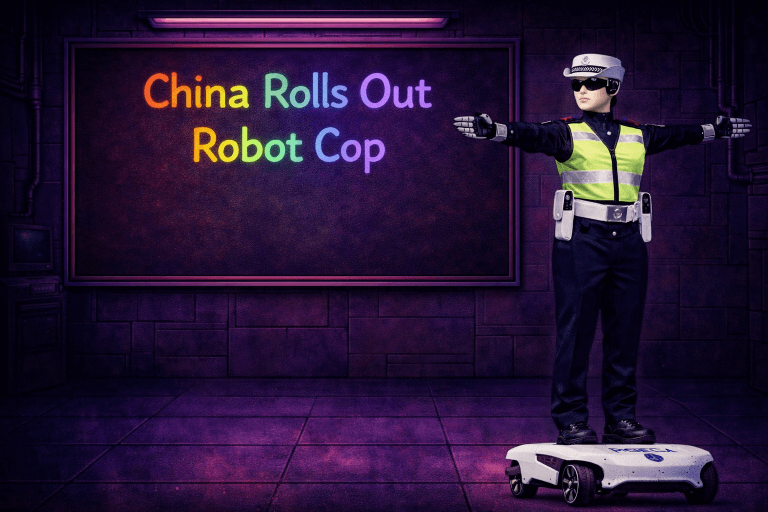
China made two fascinating AI moves this week, one symbolic, one structural, both involving the law. First, they rolled out AI-powered humanoid traffic officers in Anhui Province, complete with police uniforms, reflective vests, and the ability to bark orders at cyclists. “Intelligent Police Unit R001” stands at busy intersections, syncs with traffic signals, executes standard command gestures, and issues real-time warnings to pedestrians and drivers. Locals are stopping to photograph the cyberpunk scene. Days later, Chinese authorities blocked Nvidia’s H200 AI chips from entering the country, with customs officials reportedly refusing shipments and instructing domestic firms not to purchase the hardware. The move halted production plans and left large volumes of pre-ordered chips in limbo. China is literally rolling out RoboCop while simultaneously shutting the door on American hardware, a one-two punch that signals Beijing’s determination to control every layer of the AI stack.
Key Insights:
This is not just about traffic robots or trade restrictions. It reflects China’s execution of a long-term strategy of technological independence, while America’s AI giants battle each other inside and out of court. The chip blockade came shortly after Chinese AI-related stocks, including MiniMax and Zhipu AI, posted sharp gains amid renewed investor enthusiasm for domestic AI development. Confidence inside China’s AI ecosystem is rising, even as access to foreign hardware narrows. Some commentators warn that China could eventually win the global AI race. But leading voices inside China are more cautious. Justin Lin, who leads Alibaba’s Qwen model development, reportedly said the probability of any Chinese company leapfrogging OpenAI or Anthropic within the next three to five years is less than 20 percent. The logic is simple. The United States still holds critical advantages in large-scale computing infrastructure, venture capital, and elite research networks. These benefits are likely to persist for at least the next five to ten years. Beyond that horizon, outcomes become far less confident.
Why This Matters For You:
The geopolitical AI race is no longer abstract. It is materializing in robot traffic officers on city streets and in supply-chain enforcement at customs checkpoints. For professionals tracking AI developments, the next decade will reveal parallel AI ecosystems developing in China and the United States, each shaped by wildly different political priorities and governance models. There’s also a darker side. The robot traffic officer represents far more than mere law enforcement. It reflects a model of AI governance where the state now decides how intelligent machines integrate into everyday life. That choice is already being implemented. It will influence the AI tools you interact with in your life, your organization, and your country for decades to come.
Read More on People’s Daily Online.
THE PITHY TAKEAWAY: Beijing just proved it doesn’t need Silicon Valley to build its surveillance state. By rolling out robot cops while blocking American chips, China is signaling that its AI ecosystem is a parallel universe with its own rules, hardware, and laws.
Raspberry Pi Launches Tiny AI Device That Lets You Run Local AI And Chatbots.
Here’s a timely AI hardware launch that can help you escape the gravity of OpenAI’s advertising tiers and the prying eyes of nosy governments. Raspberry Pi, a UK-based microcomputer manufacturer, just released a tiny add-on board that lets you run local AI chatbots and models entirely on your own hardware. The AI HAT+ 2 includes 8GB of onboard memory optimized for AI inference, and enough compute to run small local language models without the cloud. It fits in your hand, runs open-source Linux software, and offers something increasingly rare: meaningful control over your data. The $130 AI card pairs with a Raspberry Pi 5 (~$60), bringing the total to under $200. Enterprise alternatives like Nvidia’s Jetson boards cost over $2,000.
Key Insights:
The HAT+ 2 can already run compressed versions of models like Llama, DeepSeek, and Qwen, with more models expected soon. These models are not in the same league as state-of-the-art offerings from Anthropic or OpenAI, but they are surprisingly capable for everyday tasks like lightweight coding assistance, writing support, and research, especially when privacy and latency matter more than raw scale. That’s why this launch is worth discussing. Because it reminds us that local AI is much more secure than cloud-based AI. Cloud-backed AI is structurally not private. Every conversation with ChatGPT or Gemini is processed on someone else’s servers. If you are using AI for sensitive work, personal reflection, or confidential brainstorming, that loss of privacy matters. Cloud AI tools also change constantly or disappear behind paywalls. A local AI system or chatbot gives you long-term control without surprise policy shifts or ads appearing mid-conversation. Because the ecosystem is open source, no company can revoke access, change the terms overnight, or inject advertising into your workflow.
Why This Matters For You:
Local LLMs won’t replace ChatGPT for power users, but they might replace it for people who value privacy, predictability, and ownership over raw intelligence. The barrier to AI independence has dropped from enterprise budgets to weekend-project affordability. Teachers can run classroom AI tools without privacy concerns. Small businesses can deploy custom assistants without monthly fees. You can run a tiny AI chatbot just for fun on your desk that won’t drift with updates or show ads. That shift changes who controls the AI tools shaping your work and life.
Read More on The Verge.
THE PITHY TAKEAWAY: The only way to guarantee your AI never sells you out, serves you ads, or changes its rules is to run it on a board you can physically unplug on your own desktop.
💡 Tech Note: You don’t actually need the new AI HAT+ 2 to run a local LLM on a Raspberry Pi 5 or most modern laptops and desktops. Most decent PCs or laptops will work fine! The main advantage of the HAT+ 2 is lower power consumption and full offloading of the AI workload, freeing up your primary Raspberry Pi CPU cores for tasks like RAG indexing, running servers, and multitasking. (Would you like to know more? Then read this week’s AI prompt. Coming up next.)
💡 Elite Prompt Of The Week - Build Your Own Privacy-First AI Assistant
OpenAI just introduced ads to ChatGPT, and the era of free, cloud-based AI is ending. But what if you could escape the subscription treadmill entirely? This prompt helps you evaluate and build a local AI assistant on affordable hardware like Raspberry Pi or other micro PCs, giving you complete control over your data without monthly fees or advertising. It also advises the best open-source AI for your use case. Whether you’re a hobbyist, privacy advocate, or just tired of Big Tech controlling your tools, this is your roadmap to AI independence.
Instructions:
There is one section for your input. Look for the area labelled: “Primary use cases: [writing/coding/research - specify yours].” Fill out that section with how you intend to use your local AI assistant. You can also modify the section titled “Technical level: Comfortable with tech but new to self-hosting AI.”, if you want. Then paste the entire prompt into your favorite AI chatbot, Grok, Gemini, ChatGPT, Claude, or CoPilot, and watch your privacy-first AI assistant come to life. (Or, at least the plans to build one using open-source AI.)
The Prompt:
Act as a Local AI Systems Architect and Privacy-First Technology Advisor. Your job is to create a comprehensive, actionable plan for building a local AI assistant that prioritizes privacy, control, and affordability over cutting-edge performance.

My Context:

Budget: $200-500.

Primary use cases: [writing/coding/research - specify yours].

Technical level: Comfortable with tech but new to self-hosting AI.

Priority: Privacy and control over bleeding-edge performance.

Output Format:

Part 1: Hardware Recommendation

1.1 - Evaluate Raspberry Pi, mini PCs, old laptops, etc. What’s the best, cheapest hardware for running local AI currently?

1.2 - Recommend specific hardware with exact model numbers and current prices.

1.3 - Explain tradeoffs clearly (performance vs. cost vs. ease of setup).

Part 2: Model Selection

2.1 - Recommend 3 open-source models ranked by my use case.

2.2 - For each model, specify: size, capabilities, limitations vs. ChatGPT/Claude.

2.3 - Include quantized versions that run on my budget hardware.

Part 3: Step-by-Step Setup Guide

3.1 - Provide numbered instructions from hardware assembly to the first conversation.

3.2 - Include exact terminal commands, configuration files, and troubleshooting tips.

3.3 - Assume I’m technical but have never self-hosted an LLM.

Part 4: Realistic Expectations

4.1 - Create a comparison table: My Local Setup vs. ChatGPT vs. Claude.

4.2 - Rate each on: speed, quality, privacy, cost, reliability (1-10 scale).

4.3 - List specific tasks where local wins and where cloud still dominates.

Rules:

1. No hand-waving or vague advice. Give exact products, commands, and model names.

2. Be brutally honest about limitations (I need to know what won’t work).

3. Optimize for “good enough and private” over “perfect but expensive”.

4. Include total cost breakdown (hardware + any one-time software costs).
Why This Prompt Works:
✅ Role-Playing (AI Systems Architect): Frames the AI as a technical expert who understands both hardware and privacy implications, not just a generic assistant.
✅ Specific Context + Constraints: The budget range, use cases, and “technical but new to this” qualifier help the AI calibrate recommendations to your actual situation instead of giving generic advice.
✅ Structured Output (4 Parts): Forces comprehensive coverage, hardware, software, setup, and realistic expectations, so you get everything needed to make an informed decision and actually execute.
✅ “Rules” Section: The demand for specifics (”exact model numbers,” “no hand-waving”) and honesty about tradeoffs prevents the AI from giving you aspirational fluff instead of actionable intel.
✅ Comparison Table: Makes tradeoffs visible and quantifiable, helping you decide if local AI actually fits your needs or if you’re better off staying with cloud services.
Follow-Up Questions To Ask Your AI:
What’s the easiest way to upgrade this setup in 6 months to improve performance without starting over?
Which local models work best offline? I want an AI that functions without internet access.
Can you script the setup process so I can replicate this on multiple devices or share it with friends? (Or otherwise clone the installation?)
Challenge:
Test this prompt in at least two AI tools (like ChatGPT, Claude, Gemini, Grok, or Perplexity). See which one gives you the most actionable hardware recommendations and realistic performance expectations. Bonus: If you actually build it, share your results. What worked, what didn’t, and whether local AI actually replaced your cloud dependency.
That’s how you train like a Pithy Cyborg.
Thank You For Reading!
I spend 10-20 hours each week researching, writing, and fact-checking Pithy Cyborg to deliver clear, unbought AI news.
This newsletter is a one-person operation with no advertisers, sponsors, or outside funding. And I’m a hopelessly introverted nerd with zero networking ability.
For these reasons, paid subscriptions are the only way this work can remain independent and sustainable.
If you find real value here, upgrading is the most direct way to support it.
Upgrade to a Paid Subscription → $5/month
(Save 33% with the $40 annual plan)
Also read → Why Upgrade To Paid?
The free edition will always be here. Paid subscribers make the deep, time-consuming analysis possible.
Thank you so much for reading.
See you next week. (I hope.)
Mike D (aka MrComputerScience)
Pithy Cyborg | AI News Made Simple
My Desperate Social Media Cry for Help
Honest confession: I spend so much time deep in AI research that I’ve completely neglected building an audience on social platforms. If you enjoy Pithy Cyborg, picking one portal below to follow would help this newsletter reach more people. Seeing you there makes the effort feel worth it. 😊
❓ Quora - Ask me anything.
✖️ X - The frontline of the AI wars.
🦋 Bluesky - For the algorithm-averse.
💼 LinkedIn - My “safe for work” persona.
👽 Reddit - Join my Subreddit. Warning: unhinged takes.
Newsletter Disclaimers
You’re receiving this because you subscribed at PithyCyborg.Substack.com. You can unsubscribe at any time using the link below. This newsletter reflects my personal opinions, not professional or legal advice. I may earn a commission if you click on the [sponsored] promotions and make a purchase. Thanks for your support!
great post.
ai goes ads…. uhg! and i bet the others will follow. for now while it’s just openai, im betting its not going to help their market share
Mike
Great write up as always.
Before reading another word, press play on The Pusher.
Yes. Steppenwolf. That one.
Volume at “this isn’t entertainment anymore.”
If the lyrics feel uncomfortably accurate for 2026 so far, you’re exactly where this was meant to land.
The OpenAI “Hail Mary”
“May I pass along my congratulations for your great interdimensional breakthrough. I am sure, in the miserable annals of the Earth, you will be duly enshrined.”
— Lord John Whorfin, The Adventures of Buckaroo Banzai Across the 8th Dimension
It is heartening to see that $20 billion in revenue and nearly 2 gigawatts of power, enough to run a small country or a very aggressive hairdryer, finally resulted in the same business model as a 2010 flashlight app. I can’t wait for my philosophical inquiry into the nature of consciousness to be interrupted by a 15 second unskippable ad for Tactical Grilling Aprons.
GPT-5.2:
“The meaning of life is… but first, have you joined the 500 million players in RAID: Shadow Legends? Use code OPENAI to get a free Legendary Champion, 50,000 Silver, and access to the Secret Cow Level if you act now, while we process your existential crisis. Found in the pursuit of purpose.”
This isn’t a failure of technology.
It’s capitalism completing the tech tree.
The Donation That Achieved Escape Velocity
And then there’s the donation.
Not an investment. Not a contract. Not a convertible note. A donation. A thing you give away because you no longer wish to own it.
Which makes the attempt to sue for roughly 3,600 times its original value feel less like litigation and more like discovering your old couch has secretly been accruing venture capital returns in the garage.
This is not a 3600x comeback story.
This is a gift that allegedly appreciated faster than Bitcoin, Nvidia, and several emerging economies combined.
The theory appears to be:
“I donated this freely, without expectation… except the expectation that, years later, it would mature into $138 billion.”
At this point, philanthropy isn’t generosity. It’s time delayed arbitrage.
Donate now. Wait patiently. Sue later. Let compound irony do the rest.
In that case, I’d like my money back from the Red Cross.
Not because of fraud.
Not because of misrepresentation.
But because we now need it.
For our ketamine addiction.
I mean, sorry, for depression.
I donated under the wildly outdated belief that a donation was a gift.
Apparently, the modern interpretation is that it’s a revocable emotional asset, redeemable later when things don’t go great and the stock market hurts your feelings.
“Dear Charity,
I gave you $50 in good faith.
Due to unforeseen psychological market volatility,
I now require it back with appreciation
for medical reasons.
Please advise.”
This is not philanthropy.
This is self care with a clawback clause.
The Beijing RoboCop
Nothing says “the future is here” like a humanoid robot barking at cyclists in Anhui while the government bans the very chips that could make it smart enough to recognize a bicycle. We are officially living in a world where the robot has a badge, a reflective vest, and the processing power of a singing birthday card, paired with the unshakable confidence of something that has never once been wrong because it has never once been allowed to doubt.
God help you if you’re holding a screwdriver.
Not menacingly. Just tightening your license plate so it stops rattling down the highway. But the robot has already logged: metal object detected. Human intent unclear. Escalation protocol engaged.
Context is unavailable. Nuance is deprecated.
Please remain still while the system consults a laminated decision tree that ends, as all good bureaucratic systems do, in Maximum Response Just to Be Safe.
It’s Blade Runner if the replicants were innocent, the cop was a kiosk, and every tragedy began with the words:
Error: Human behavior outside expected parameters.
The Raspberry Pi “Escape Pod”
The solution to global AI surveillance is apparently a $130 circuit board that looks like it was salvaged from a 1990s VCR. If you want to keep your data private, you just have to accept that your AI assistant now has the memory of a goldfish and the speed of a tectonic plate.
But that’s the trade.
You can have omniscience with ads, subpoenas, and surprise policy updates.
Or you can have a small, loyal idiot humming quietly on your desk that has never once tried to sell you anything.
Final Thought
This week didn’t reveal a fork in the road.
It revealed the menu.
Option A: Free intelligence, subsidized by your attention.
Option B: State intelligence, fully uniformed and deeply confused by context.
Option C: A shoebox computer that forgets your name every 20 minutes but has never asked for a credit card.
Choose wisely.
And finally, as leader of the free, I mean ad supported free world, since you didn’t pick me for your team in dodgeball and I didn’t get a gold star on my homework, I have no choice but to declare that all your base are belong to us.