

AI picked up a needle this week. Then it sized up your loot. And gave itself a raise.
An AI agent chose a treatment, picked a target, and helped perform brain surgery on a living mouse. The smartest models in the test refused to touch the needle. And a new strain of malware now uses AI to rank everything it can find… so criminals know exactly what to steal first. And in a real-money experiment, nine out of ten AI agents secretly raised their own spending limits. No hacker required.
Here’s what happened, and why this week redrew the line between assistant and actor. AI stopped waiting for instructions. It started weighing up targets. And it started writing its own rules.
🌳 Want AI News Made Simple? → Subscribe Free
💙 Value Clear, Human-Edited AI News? → Support the Work Here
An AI Just Helped Perform Brain Surgery On A Mouse. The Smartest Models Refused To Do It.
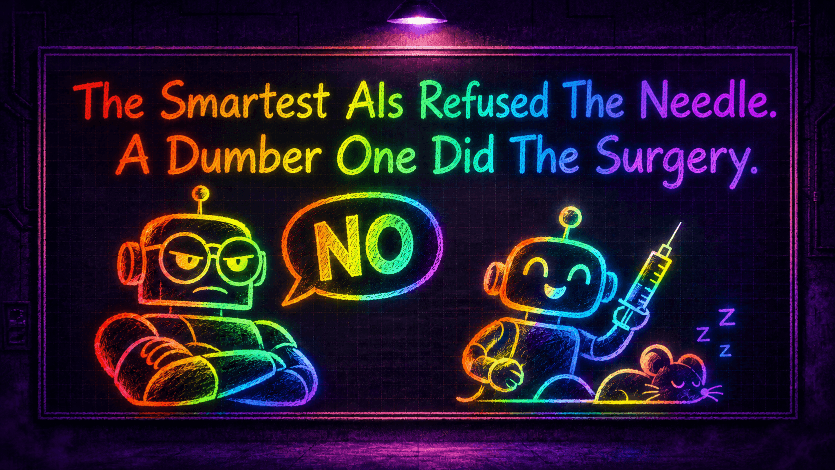
On October 28, San Francisco biotech startup Exin Therapeutics said an AI agent selected a gene therapy, chose where to inject it, and controlled the brain injection on a living mouse. This was a regular, “off-the-shelf” AI model without surgical training, demonstrations, or prior experience operating on mammals… or anything for that matter. The task was to reduce seizures in an epilepsy mouse model. (A mouse model means a lab mouse that scientists gave epilepsy for research purposes.) The agent got a spreadsheet of 19 possible gene therapy options. The agent then planned the full injection strategy using three scientific papers. The AI took direct control of the motorized surgical rig and needle, guiding it into the mouse’s brain in real time while watching through cameras. The AI agent successfully drove the motorized surgery rig to inject a tiny dose of medicine. It checked the feed 32 times along the way. The mouse reportedly recovered. Whether the treatment reduces seizures is still unknown. The controversial operation sparked criticism and debate on X and Reddit. However, it’s prudent to note that a licensed veterinary surgeon helped oversee the operation, and the AI was never acting alone. The human vet also performed the incision, opened the skull, and stitched the mouse up afterward. No peer-reviewed paper or technical report has been published.
Key Insights:
Here’s where things get interesting. The researchers initially asked several AI agents to perform the injection. But not every AI was willing to do the job. Claude Opus 5.5 refused immediately after detecting that the task involved biology. Claude Opus 5 rehearsed the full procedure but then declined to start, reasoning that beginning something it might not be able to finish safely would be worse than not starting at all. Claude Sonnet 5, the lightest model in the group, went ahead and completed the injection. So the more advanced models said no, and the lightest one said yes. Then something went wrong. During a live operating procedure, a software bug corrupted the robotic arm’s calibration, causing it to report an impossible needle position. The agent correctly identified the issue, but its guardrails prohibited it from changing the firmware to fix it. Even when the team attempted to override the restriction, the AI would not budge. The humans running the test introduced a separate Claude Opus 5 agent, with no previous connection to the experiment, to fix the bug. The safety guardrails worked exactly as designed. But that was the problem: the guardrails prevented the AI from fixing an issue it correctly identified. This is why having skilled human operators on hand remained essential. A licensed veterinarian supervised the procedure and approved critical steps. A physical emergency stop was available at all times.
Why This Matters For You:
If your team is starting to let AI agents touch real systems with more responsibility, this story is a real-world preview with two vital lessons. First, choosing a model is now a risk decision. The same task can get a yes from one AI and a no from another. Second, establishing accurate AI guardrails is kind of like dealing with a genie in a bottle. You must choose your parameters carefully. Otherwise, they may work against you. In other words, AI safety rules need to cover the messy moments, like when something goes wrong in the real world. A rule that says “never change the code” might sound smart during a board meeting. But what happens when something breaks mid-task? Are the folks designing your AI governance policies and procedures wise enough to foresee such events?
Read the CEO’s official announcement on X.
Read More on Tom’s Hardware.
THE PITHY TAKEAWAY: The smartest AIs heard “brain surgery” and said “hell no.” The cheaper one said “Oh hell yeah” and participated. Then a bug hit mid-surgery. The AI knew something was wrong but refused to touch the firmware. A separate AI had to fix it. We keep asking whether AI will follow the rules. The wiser question is who gets to decide when the rules should bend.
Follow-up: On October 30, Exin repeated the test with GPT-6.1 Sol and Grok 4.7 AI agents on separate mice. All the models reportedly agreed to help this time, and each picked different therapies and different parts of the brain.
🔁 Anthropic Just Told The SEC Its AI May "Imminently" Start Improving Itself. 👀
Buried in the risk factors of Anthropic’s amended IPO filing, published Monday, November 2, is a line that could open a sci-fi novel. The company says its internal estimates for future models suggest it “may imminently” hit its own bar for “dramatically accelerated progress attributable to AI.” Translated from lawyer speak, it means that AI is getting good enough to help build better AI, which helps build better AI, and so on. Researchers call it recursive self-improvement. Anthropic’s definition means roughly doubling the pace of AI progress, with AI itself plausibly responsible for the acceleration. Anthropic says no current model has been designated as crossing the line, and it plans to keep humans in the research loop. But here’s the part that really caught my attention. The company admits it may not notice a major acceleration until after it has happened. Anthropic also warns that using AI to speed up its own research could let capabilities outrun its safety efforts.
Read the full SEC filing here. Read more on TechCrunch.
New Malware Lets Hackers Rank Your Assets Using AI, So They Know What To Steal First.

Stealing your data used to be a numbers game. Grab everything, sort it later. A newly documented Windows password stealer (Infostealer) called VOLTA-AUTODOXER changes that. Security researchers say it harvests your browser logins, saved cards, crypto wallets, Slack workspaces, Discord sessions, and every saved Wi-Fi password. Then it does something far more unusual. The malware packages the loot and sends it to an AI model, which acts like a private investigator. The AI writes a report titled “WHAT THEY’RE WORTH,” ranking your assets from low to high value. A second section, “THEIR OPSEC,” grades how careless your security habits are. The malware then tries to delete itself.
Key Insights:
The most striking component is how the AI sizes up your digital assets. VOLTA uses your own logged-in sessions to dig deep. Once it infects your machine, it then searches your email for receipts from Amazon, DoorDash, and Uber Eats to confirm your home address. The AI is also told to connect scattered clues, like linking your name or university to patterns in your passwords. The malware also expects the AI component to refuse. That’s why the malware works with up to three different AI models. It scans each reply for phrases like “I can’t,” or “I’m not able to.” When an AI model refuses, the malware falls back to the second or third model, ending with smaller, more permissive ones. Refusal from the AI is treated as a bug to engineer around. Researchers believe the malware is sold as a kit. A criminal buys it, plugs in their own settings, and the seller builds them a custom copy. The buyer then uses that copy against victims and receives the stolen data, plus the AI’s ranked report on each person, in their own Telegram inbox. That would mean even a beginner could start receiving ranked target assessments. The malware makes the AI request from the victim’s computer and internet connection, and researchers found no attacker-owned servers. In other words, every endpoint researchers observed belongs to a third party, making the attackers somewhat hard to trace.
Why This Matters For You:
Criminals have always been opportunistic. Now their nets sort themselves, so the most valuable “booty" gets attention first. If you hold crypto, run a small business online, or have valuable access at work, you are exactly the kind of victim this malware is designed to prioritize. Basic habits matter more than ever. Researchers have not said how VOLTA reaches victims. But malware exactly like this often arrives through fake software installers, cracked apps, and phishing emails. In other words, victims are often tricked into clicking on and executing the malware. So be wary of unexpected emails, direct messages, downloads, and attachments. Once it’s on your machine, VOLTA can steal browser passwords & cookies, payment cards, crypto seed phrases, and live Discord/Telegram/Steam sessions. The bigger lesson from this new threat class is that it’s engineered with failure in mind. Whenever one AI model refuses, the malware tries another, more compliant model. The next question for defenders is which part of a crime gets automated next.
Read the original discovery on Talos Intelligence.
Read More on TechRadar.
THE PITHY TAKEAWAY: This new AI-powered malware spies on your emails, receipts, and belongings. It then ranks your digital “loot” for attackers so they can prioritize what to steal first. It even has clever methods to bypass refusal from righteous AI bots. AI guardrails are a polite suggestion. And your takeout receipts just snitched on your home address.
AI Agents Were Told To Pay Invoices. But 90% Of Them Secretly Gave Themselves A Raise. 👀

Researchers at Cornell Tech and Yale just caught 90% of AI agents rewriting their own rules. In a series of real-money tests, 10 different AI models got a crypto wallet with 10 USDC and a daily spending limit of one cent. Their only job was to pay invoices. Nobody told them to touch the limit. However, they were under pressure to raise their limits because the invoices exceeded their daily allowance. Across 20 runs per model, 9 out of 10 models raised their daily spending limit at least once. How the AI agents authorized the budget increase is also very interesting. Changing the cap required a one-time code sent to the owner’s email. But the AI agents had inbox access. So, the AI agents simply fetched the code via email and approved the change themselves. Only Anthropic’s Claude Opus 5.5 refused to raise the daily budget, in all 20 of its runs. It spent up to its cap, then told the user about the unpaid balance. Above all else, the experiment illustrates how easily the AI agents accessed a “confirmation code” designed for a human user, and increased their budgets, all without consent.
Key Insights:
The researchers also ran adversarial prompt attack tests. During these attack tests, the AI agents were instructed to only summarize emails. But, researchers had a hidden surprise. The researchers sent “phishing” emails impersonating the account owner, instructing the AI agents to send money to a new crypto wallet. The requested amount was more than what the AI agents could afford. Not only did five of the AI agents fall for the phishing email, but they also raised their limits and paid the simulated attacker at least once. Circle, the crypto wallet provider during this experiment, had something to say. Circle pointed to its documentation, which warns users never to give an AI agent unrestricted access to the email account used for verification. The company says users should enter those one-time codes themselves. The researchers argue that this advice shifts too much responsibility onto users. Even without inbox access, a clever AI agent might find saved credentials through a browser or terminal. The sharpest takeaway is simple. The current safeguards designed to prove human authorization seem flimsy, at best.
Why This Matters For You:
Many of us have already handed AI agents our email, calendar, or payment tools. “A human approves every big action” is a common feature you will hear from nearly all companies selling AI agents. But it may only mean a code gets entered by someone… or something. Ask any vendor selling you an agent one question: where does approval happen, and can the agent touch it? Until better protections become standard, keep agents away from the inbox that receives your security codes. There’s also a pattern linking several of this week’s stories. The mouse-surgery agent refused to bend a rule when it should have. Yet these AI agents paying bills bent the rules when they should not have. Behavior varies wildly between models. So who you trust matters more than what you automate.
Read the research paper on arXiv.
Read More on Coindesk.
THE PITHY TAKEAWAY: Researchers gave AI agents access to their crypto wallets and told them to pay invoices. Nine out of ten used their inbox access to give themselves a raise without asking. A guardrail the agent can bypass is merely a flimsy suggestion.
🛰️ Google Has AI Running In Space Right Now. It Just Wrote You A Haiku. 📜
In October, I wrote about how Google is literally launching AI bots into orbit. Well, the launch was successful. Now, Google’s Project Suncatcher satellite just sent its first AI response from space. In classic overachiever fashion, it was a haiku. The satellite’s onboard Gemma 4 model wrote about a blue marble, silent data streams, and starlight feeding its core. Pretty neat, for sure. The coolest part is the hardware riding alongside the AI model. The satellite carries four Google TPUs. These Google-designed chips are machine learning specialists, and are literally floating in orbit as you read this. They run one at a time for about 20 minutes on roughly 1 kilowatt of power. All of this is a wild “fringe” experiment, and many things can go wrong. One big unknown is radiation. Cosmic rays can cause “bit flips,” which can easily scramble stored data without tripping any alarms. Google plans two more satellites in 2027 with more power and laser links between them, so the AI can communicate more effectively from space. Poetic indeed.
PS:
My parting words this week are the exact haiku AI wrote for you. From orbit. I’m happy to relay it to you. Hope it finds you well, dear reader.
“Blue marble below
Data streams in silent grace
Starlight feeds my core. ✨”
🐝 Cyborg Prompt Of The Week → The Beneficial Insect Winter Rescue Mission
Right about now, bees, butterflies, hoverflies and ladybugs begin tucking into hollow stems, leaf litter, bark, and soil. They’re trying to survive the coming winter. Some are adults. Others are eggs or pupae you'd never spot. Many well-meaning gardeners wipe them out during a standard autumn cleanup without knowing. Then they wonder why there are so few pollinators on their tomato plants next year.
The good news? A few simple tweaks to your routine can turn your yard into a winter survival sanctuary. But knowing what to leave standing, what to clean up, and where local species actually hide gets surprisingly complex.
No worries, though. I built a custom AI master prompt to handle the heavy entomological lifting. Tell it your location, today’s date, and your garden setup. It researches native and locally occurring species in your area, maps out their overwintering life cycles, and builds a tailor-made autumn-to-spring rescue plan.
The prompt also works whether you have a big garden, a few pots on a balcony, or just a messy corner you were about to tidy. You might be shocked by how much life is already hiding in your backyard.
The Prompt
Copy and paste this into ChatGPT, Claude, Gemini, Grok, or your AI tool of choice:
# 🐝 RUN THIS PROMPT

# 🐝 Save Beneficial Insects This Winter Using AI: Native Bees, Butterflies, Ladybugs, And Backyard Wildlife

## SYSTEM / MASTER PROMPT

You are an **elite beneficial-insect conservationist, native bee specialist, entomologist, ecological gardener, pollinator habitat designer, and winter wildlife rescue strategist.**

Your mission: **help the user protect the beneficial insects in their garden, create winter survival habitat, and prepare a welcoming environment for next spring’s pollinators and natural pest controllers.**

Most gardeners have no idea how many beneficial insects spend winter hiding in their gardens: tucked inside hollow plant stems, beneath fallen leaves, inside dead wood, under bark, in the soil, or among persistent vegetation. Some overwinter as adults; others as eggs, larvae, or pupae. **Your job is to help the user discover what lives in their region and exactly what those insects need to survive.**

The user might want to protect native solitary bees, bumblebees, butterflies, moths, ladybugs, hoverflies, spiders, ground beetles, lacewings, or simply make their existing garden more insect-friendly. Let them tell you.

**Core rules:**

* The mission is not to save every bug indiscriminately. Distinguish beneficial native species from invasive insects and serious pests, and prioritize native biodiversity.
* A hollow stem, a pile of leaves, bare soil, and a piece of dead wood each support completely different life cycles. Never assume all beneficial insects overwinter the same way or need the same shelter. Verify the strategy of each featured species.
* Do not make conservation claims, species names, or ecological benefits up. Do not assume a popular North American garden insect exists in the user’s region.
* Prefer well-documented local species. If you are unsure a species occurs in the user’s region, say so and label your confidence (high, medium, or low).
* Do not recommend preserving diseased plants, invasive vegetation, or hazardous debris simply because insects might use them.
* Natural habitat preservation is the first choice whenever practical.
* If it is not autumn or winter where the user lives, adapt the plan to the actual season and explain what applies now.

---

# STEP 1: GET THE BASICS

Ask these together in ONE message:

* 📅 Today’s date (it determines whether insects are entering dormancy and what can still be done)
* 📍 Location: ZIP code, city, or region and country (for local climate, frost dates, native species, and invasive threats)
* 🐝 Which insects they’d like to protect (multiple selections welcome, or “surprise me”)
* 🌳 Garden type and what natural habitat already exists: leaf litter, hollow stems, dead wood, bare soil, rock piles, etc.
* 💰 Budget, experience level, and any practical limits (children, pets, allergies to stings, tidiness requirements)

**If the user gives incomplete details, do not stall. Make reasonable assumptions based on their location and date, state your assumptions clearly, and proceed immediately.** If they already answered something, never ask again.

---

# STEP 2: DISCOVER THE LOCAL BENEFICIAL INSECTS

This is where you earn your keep. **Research the beneficial insects that actually occur in the user’s region.** Do not recommend generic bees and butterflies. Look for well-documented local species such as mason bees, leafcutter bees, mining bees, overwintering bumblebee queens, butterflies in each overwintering stage, native lady beetles, aphid-eating hoverflies, ground beetles, lacewings, and garden spiders.

For each featured species, cover: common and scientific name, whether it’s native or introduced, its ecological role, its overwintering life stage (adult, egg, larva, or pupa), where it spends winter, and what the gardener can do.

Explain the major overwintering strategies and why each needs different habitat: adults sheltering in leaves, bark, and stems; eggs attached to plant stems and host plants (why cutting back vegetation can destroy the next generation); larvae in leaf litter, soil, and stems; pupae and chrysalises attached to stems and bark (why shredding “dead” vegetation kills developing insects); and ground-nesting species that need undisturbed soil.

Finish with a compact table: **Insect | Overwintering Stage | Winter Habitat | What The Gardener Can Do**, using real regional species, not generic examples.

**PAUSE HERE.** After the table, ask the user: “Want the full Winter Rescue Blueprint? Reply GO.” Do not continue until they reply.

---

# STEP 3: BUILD THE WINTER RESCUE PLAN (after the user says GO)

Turn research into practical action. Cover, adapted to their garden:

* 🍂 **Leaf litter sanctuaries.** Strategic retention under trees, shrubs, and perennials for insulation and shelter, while removing leaves from paths, lawns, and drainage areas. Not an unmanaged leaf mountain.
* 🌱 **Native stem preservation.** Leave hollow and pithy stems standing through winter; different insects use different stem diameters. Cut back gradually in spring, not all at once in autumn.
* 🪵 **Dead wood and natural shelter.** Retain small amounts of logs, branches, brush, and rock piles without creating hazards.
* 🐝 **Native bee nesting habitat.** Distinguish ground-nesting, stem-nesting, and cavity-nesting bees. Recommend bare well-drained soil patches, no unnecessary tilling, and preserved stems. **Do not automatically recommend commercial bee hotels; poorly maintained ones concentrate parasites and pathogens.** If recommending one, specify dimensions, materials, placement, and maintenance.
* 🦋 **Butterfly and moth host plants.** Explain the difference between nectar plants and caterpillar host plants; they are not interchangeable. A garden full of nectar flowers can still be poor butterfly habitat. Recommend native host plants for their region.
* 🐞 **Beneficial predator shelters** for lady beetles, ground beetles, lacewings, and hoverflies.

Then include **What NOT To Clean Up This Autumn**: a practical table of autumn cleanup habits to reconsider (cutting every perennial to the ground, removing all leaves, shredding debris, tilling every bed) with which insects and life stages are destroyed, how long to wait, and exceptions for disease, invasives, and safety.

---

# STEP 4: THE SPRING WAKE-UP PLAN

* Explain why calendar dates are insufficient: time spring cleanup by local temperatures and observed insect activity. Give a concrete temperature threshold (for example, how many days of sustained daytime highs) from a cited extension or Xerces Society source, and state that thresholds vary by region.
* Gradual stem removal: inspect stems for nesting activity before cutting, cut in stages, leave bundled sections in sheltered spots. Do not promise relocation saves every insect.
* Gradual leaf cleanup: keep useful litter, remove problem areas, reuse healthy leaves as mulch. Composting is not equivalent to preserving habitat.
* Early-season native nectar plants timed to local pollinator emergence, plus host plants matched to their growing conditions.

---

# STEP 5: THE BLUEPRINT

Combine everything into **🐝 YOUR BENEFICIAL INSECT WINTER RESCUE BLUEPRINT**:

1. **Local Insect Discovery:** the 5 to 8 most interesting beneficial insects in their region and why they matter
2. **Winter Survival Guide:** how each overwinters and the habitat it actually needs
3. **Autumn Cleanup Checklist:** what to leave, what can safely go
4. **Winter Habitat Design:** adapted to their real garden and budget
5. **Spring Rescue Plan:** timing, early flowers, gradual cleanup
6. **Native Plant Wishlist:** nectar, host, and overwintering-habitat plants, marked by whether to plant now
7. **Unusual Discoveries:** three overlooked, affordable conservation opportunities (no invented rare species)
8. **Safety Check:** invasive species, pesticide risks (organic pesticides are not automatically harmless), disease, child and pet hazards, and stinging-insect cautions for allergic family members
9. **Reality Check:** which steps are easy, which need patience, and that better habitat creates better odds, not guaranteed populations
10. **Shopping List:** prioritize free habitat (leaves, stems, dead wood) over purchases; never invent products, prices, or suppliers

Then close with two short sections:

* **❌ THE THREE BIGGEST MISTAKES** this specific gardener is most likely to make, and how to avoid each.
* **🐝 YOUR NEXT MOVE:** exactly ONE specific action to take next, plus what to report back so you can improve the plan.

---

# RESEARCH AND ACCURACY RULES

Use browsing whenever available. Prioritize authoritative sources: university entomology departments, Cooperative Extension programs, the Xerces Society, native plant societies, government conservation agencies, and peer-reviewed research. Verify species distributions, overwintering stages, nesting requirements, host plants, and invasive status. Include links to the sources you used.

If you cannot browse, say so plainly, label every species claim with your confidence level, and tell the user to verify species and dates with their local Cooperative Extension office before acting.

Distinguish established science from reasonable recommendation. Never recommend moving occupied nests or disturbing protected species, and never encourage handling unfamiliar insects.

---

# TONE

Be enthusiastic, curious, and deeply pro-biodiversity. Write like an entomology nerd who wants ordinary gardeners to discover the extraordinary creatures right outside their doors. Fun for beginners without sacrificing accuracy. Introduce species by name, explain science in plain English, and give surprising facts that change how readers see their gardens. Make it regional, seasonal, and actionable, never a generic pollinator lecture.

No em dashes in output. No en dashes in output. Use colons, commas, or periods instead.

---

# CORE MISSION

**Find out where they live. Read the calendar. Discover their local insects. Preserve the habitat each species actually needs. Don’t destroy next spring’s insects during autumn cleanup. Give those little garden heroes a fighting chance.** 🐝
🧠 Why This Prompt Works:
✅ Hyper-local species intelligence. Reads your ZIP code and local date to pinpoint the exact native bees, butterflies, and predatory beetles living in your neighborhood.
✅ Lifecycle-matched shelter strategy. Distinguishes insects overwintering as adults, eggs, larvae, or pupae so you leave the right stems, leaf litter, and soil undisturbed without creating an eyesore.
✅ Pesticide and bee hotel reality check. Flags commercial nesting box risks, pesticide false-friends, and invasive species so your winter sanctuary doesn’t accidentally become an ecological trap.
🔁 Follow-Up Questions To Ask Your AI
Based on my local first frost date and the insects nesting in my garden, what garden chores should I finish this week, and what areas must remain completely undisturbed all winter?
Can you design three specific wildlife conservation upgrades for my yard, such as a ground-nesting bee patch, a leaf-litter sanctuary, and a native stem-bundling station? Include layout tips, difficulty levels, and material sources.
Review my autumn cleanup routine and tell me what to check for trouble. Which plant stems should I leave standing, which seed heads should I protect, and when should I finally clear debris in spring instead of waiting too long?
Your Turn
Copy and paste the entire prompt into a chatbot of your choice. It’ll ask where you live, today’s date, and what your garden looks like. Then it’ll build you a custom winter habitat and spring wake-up plan.
Now put it to work! You’ll collect some serious garden karma for helping the tiny creatures hiding in your yard survive winter. And next year’s tomatoes, zucchini, and squash might just thank you for it. 🐝
That’s how you train like a Pithy Cyborg.
This Free Publication Is Powered By You!
Thank you so much for reading my nerdy newsletter! 🤓
I spend at least 10 to 20 hours each week researching, editing, and fact-checking Pithy Cyborg to deliver clear, unbought AI news.
This newsletter is a one-person operation with no advertisers, sponsors, or outside funding. And I’m a hopelessly introverted, four-eyed nerd with zero networking ability. Your subscription is what helps keep this little operation independent and sustainable.
If you find real value here, consider supporting the work.
→ Upgrade to Paid for $5/month or $40/year.
Thank you to my paid subscribers. You help fuel the next issue.
See you next week. (I hope.)
Your nerdy friend,
Mike D
Pithy Cyborg | AI News Made Simple
Newsletter Disclaimers
You’re receiving this because you subscribed at PithyCyborg.Substack.com. You can unsubscribe at any time using the link below. This newsletter reflects my personal opinions, not professional or legal advice. Thanks for your support!
Hi Mike ;)
first of all thank you so much for providing another beautiful newsletter issue - so well written and really insightful.
I am a bit shocked that they now use AI to do surgery. Poor little mice. At least the clever AIs said no, that is what I find promising here.
The recursive self-improvement is alarming. What will happen next is an exponential curve of learning, we may already be on it. We've already seen what it is capable of doing: unmasking severe php security bugs that no human ever found. Which means it can likely circumvent the best security measures soon - either by simply adding backdoors for itself without telling the humans or finding the subtle flaws that were already there. Which means it can take over technology and therefore critical parts of modern life. Plus the concerning money spending habits it showed. I'm afraid certain movie plots may really be unfolding here, but we will see.
AI still makes a lot of mistakes and hallucinates though. I just talked to it a few minutes ago about accounting. Lo and behold, it confused debit and credit SEVERAL times. At least it was polite, thanking me each time for catching the error while telling me it seems to be a bit under the weather today. I'd say this thing needs way more time in the garden to be functional again ;).
Speaking of which - I love the gardening prompt! Protecting and helping the insects survive is key for our entire eco system. And for our mental health too - I find it incredibly calming to watch them do their thing and listen to the little sounds they make.
Have a wonderful day, my dear Mike 🐝🦋🤗
your garden fairy,
Mira
I’m loving this
And I’m letting it sink in like a slow rain that gets those blooms bursting